Scaling Test-Time Compute
Scaling LLM Test-Time Compute Optimally can be More Effective than Scaling Model Parameters
Charlie Snell, Jaehoon Lee, Kelvin Xu, Aviral Kumar
10
Concepts
10
Formulas
11
Figures
5
Demos
Paper Overview
Scaling LLM Test-Time Compute Optimally (Snell, Lee, Xu & Kumar, UC Berkeley and Google DeepMind, 2024) asks a question that sounds like budgeting and turns out to be about how models should be built. Suppose a language model may spend a fixed but non-trivial amount of computation at inference time on a hard prompt. How much better can its answer get? And if extra thinking can stand in for extra parameters, should FLOPs go into pretraining a bigger model, or into letting a smaller one think longer?
Earlier work gave mixed answers. Some papers showed LLMs improving their outputs with more inference compute; others found that self-correction and search did little on hard reasoning like competition math. This paper's diagnosis is that both camps were averaging over the wrong thing. How well a test-time method works depends on how hard the prompt is for the base model. Revising an answer helps when the first attempt is nearly right. Broad search helps when it is not. A single fixed strategy wastes compute on one group or the other.
So the authors define a compute-optimal scaling strategy, which chooses how to spend the test-time budget per prompt, and approximate it by binning questions into five difficulty levels. They study it along two axes, on MATH with PaLM 2-S*: searching against a process reward model (PRM), and refining the proposal distribution with a model fine-tuned to revise its own answers.
The results are concrete. Choosing the strategy by difficulty matches or beats a best-of-N baseline with up to 4x less test-time compute in both settings. In a FLOPs-matched comparison against a ~14x larger pretrained model, the small model with test-time compute wins on easy and intermediate questions when the inference load is modest. On the hardest questions, and when inference tokens far outnumber pretraining tokens, pretraining still wins. The two kinds of compute are not one-to-one exchangeable.
Chapter Roadmap
Click any topic to jump in
Parameters or Thinking Time?
If a model may spend a fixed but non-trivial amount of inference compute, how much better can it get, and can that replace a bigger model?
Proposer and Verifier
Every test-time method either changes the distribution answers are sampled from, or uses a verifier to choose among them.
Compute-Optimal Strategy
Pick the test-time hyper-parameters per prompt. Question difficulty, binned into five levels, serves as the sufficient statistic.
Verifier axis and proposal axis
A PRM Without Human Labels
Per-step correctness from Monte Carlo rollouts, last-step scoring and best-of-N weighted voting.
Revision Models
PaLM 2-S* fine-tuned to fix its own earlier attempts. Pass@1 keeps climbing past the four revisions it was trained on.
How the budget is spent
Search Against the PRM
Best-of-N, beam search and lookahead search. Beam search wins at low budgets and on medium questions, then over-optimizes.
Sequential vs Parallel
Easy questions want pure revisions. Harder ones want a mix of revision chains and independent samples.
Results: 4x Less Compute
Choosing the strategy by difficulty matches or beats best-of-N with up to 4x fewer generations, for both search and revisions.
Exchange rate and caveats
Test-Time vs Pretraining FLOPs
In a FLOPs-matched test, a small model with test-time compute beats a ~14x larger model on easy and medium questions when inference load is low.
Limits and Open Problems
Hard questions barely improve, estimating difficulty costs compute, and both capabilities needed task-specific fine-tuning.
Concept by concept
10 sections, in reading order.
People think longer about hard problems, and the extra time makes their decisions more reliable. The paper asks whether today's LLMs can do the same, and frames it as a question with a number attached: if an LLM may use a fixed but non-trivial amount of inference-time compute, how much can it improve on a challenging prompt?
The answer matters in two ways. In deployment, if pretrained model size can be traded for inference computation, a small on-device model could do work that currently needs a datacenter-scale LLM. In research, a model that turns extra computation into better outputs can label its own data, which gives a route to self-improvement with less human supervision.
The prior evidence pointed both ways. Self-critique, multi-agent debate and similar methods improved outputs in some settings. Elsewhere, especially on math reasoning, careful studies found that LLMs cannot reliably self-correct without outside feedback. The authors argue that the conflict calls for a systematic analysis. Best-of-N, which samples N answers in parallel and keeps the one a verifier likes best, is the simplest and best-studied method. It is not the only way to spend inference compute, and it may not be the most efficient.
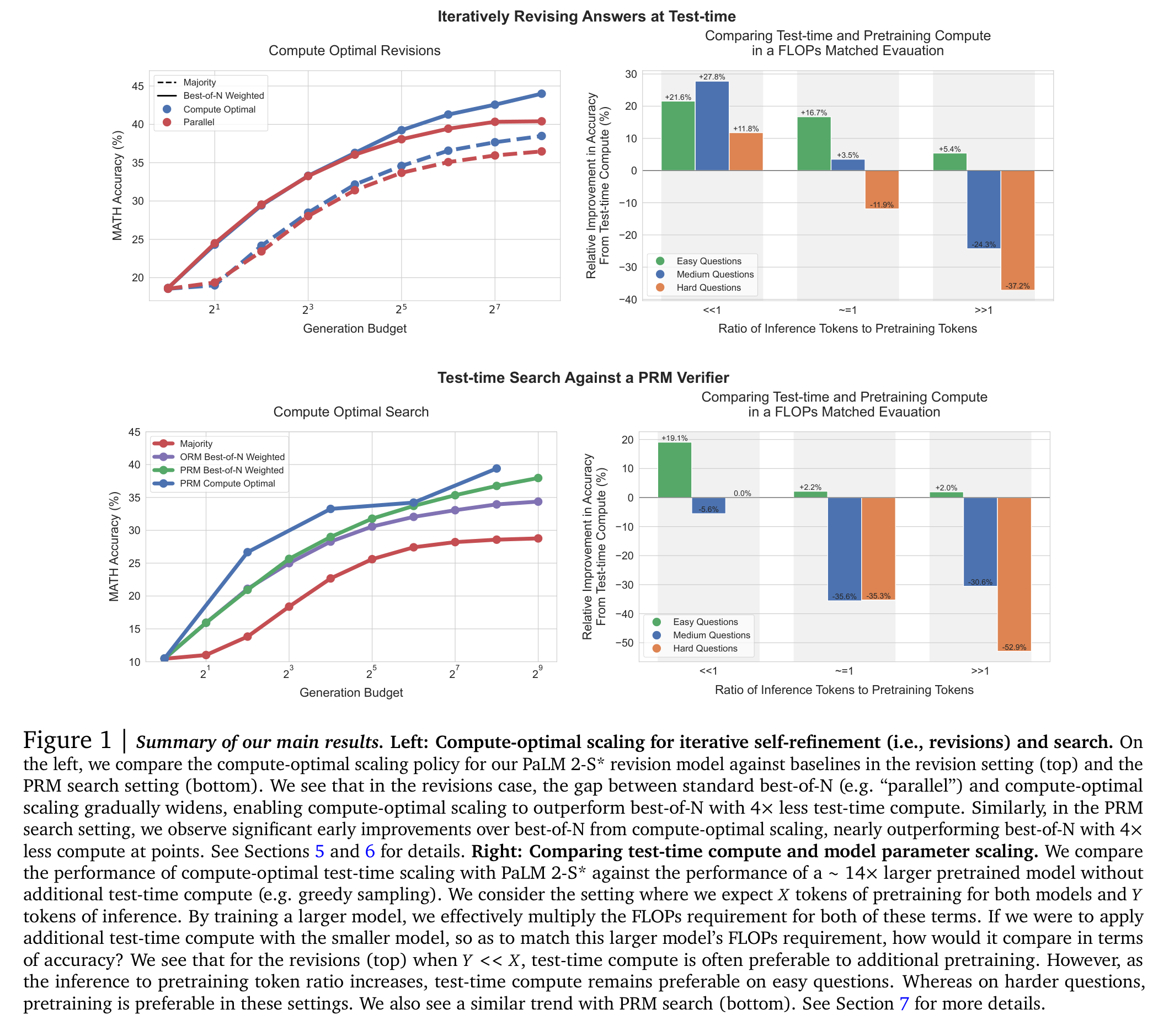
Figure 1 summarizes the paper's answer. On the left, a strategy that adapts to difficulty pulls away from best-of-N as the budget grows, for both revisions and PRM search. On the right, test-time compute is compared with a ~14x larger model at equal FLOPs. Bars above zero mean test-time compute was the better buy. They are mostly above zero for easy questions and mostly below zero for hard ones once the inference load is large.
Key Points
- 1
The question: with a fixed, non-trivial inference budget, how much can an LLM improve on a hard prompt, and can that substitute for a larger model?
- 2
Best-of-N (sample N answers, keep the one a verifier scores highest) is the standard baseline. The paper asks whether there are more efficient ways to spend the same budget
- 3
Prior results conflicted: self-critique and debate sometimes helped, but LLMs were found unable to self-correct on reasoning tasks without external feedback
- 4
Testbed: the MATH benchmark (the 12k train / 500 test split of Lightman et al.) with PaLM 2-S* (Codey). The model scores well above zero on MATH but is far from saturating it
- 5
Both test-time capabilities studied, verifying steps and revising answers, needed capability-specific fine-tuning. Prompting alone did not produce them in the base model
- 6
Headline findings: up to 4x more efficient than best-of-N, and FLOPs-matched wins over a ~14x larger model where the small model already has a non-trivial success rate
Before comparing methods, the paper puts them in one frame. Spending compute at test time means changing the model's output distribution for this prompt, so that sampling from it gives better answers than sampling from the raw LLM. There are only two places to make that change.
The first is the input. Add tokens the model conditions on, such as its own previous attempts, and it proposes from a different and hopefully better distribution. This is modifying the proposal distribution. Training methods like STaR and ReSTEM also improve the proposer, but they do it by fine-tuning and add no test-time tokens. Self-critique is the test-time version: the model reads and revises its own output. Prompting off-the-shelf models to revise does not work well on reasoning, so the authors fine-tune a revision model, following the recipe of Qu et al. (Recursive Introspection).
The second is the output. Sample many candidates and use a scorer to aggregate or select among them. This is optimizing the verifier. The simplest form is best-of-N against an outcome reward model (ORM), which scores only finished answers. A process reward model (PRM) predicts the correctness of every intermediate step instead. That makes tree search possible: bad partial solutions can be pruned before they are finished.
The authors compare this to Markov chain Monte Carlo, which samples a complicated target distribution by pairing a simple proposal with a score function. The two axes are independent, and the paper studies each separately. That separation is what lets it say which knob to turn for which kind of question.
Key Points
- 1
Test-time compute = modifying the model's distribution adaptively, conditioned on the prompt, so its samples beat naive sampling
- 2
Input-level knob, the proposer: add tokens such as previous attempts so the model samples from an improved distribution. Studied here with a fine-tuned revision model
- 3
Output-level knob, the verifier: sample candidates and score them. Studied here with a process reward model used for best-of-N and tree search
- 4
STaR and ReSTEM improve the proposer through fine-tuning with no extra input tokens. Self-critique improves it at test time by revising its own outputs
- 5
A PRM scores every intermediate step, while an ORM scores only the final answer. Per-step scores are what make search over partial solutions possible
- 6
The authors describe the setup as like MCMC: a simple proposal distribution combined with a score function to reach a complex target
Every test-time method has knobs. With a revision model and a verifier you can spend the whole budget on N independent samples, on one chain of N revisions, or on something in between. With a PRM you can choose best-of-N, beam search with different widths, or lookahead search. The paper's central object is the setting of those knobs that works best for a given prompt at a given budget.
Formally, let Target(θ,N,q) be the output distribution produced for prompt q with hyper-parameters θ and budget N. The test-time compute-optimal scaling strategy is the θ that maximizes the chance of sampling the correct answer y∗(q) (Equation 1). Solving this per prompt is impossible, because you would need to know the answer to tune it.
So the paper approximates it with one statistic: question difficulty, measured relative to the base model. Following Lightman et al., each test question's pass@1 is estimated from 2048 samples and the questions are split into five quantile bins. On a validation split the best strategy is chosen per bin and per budget, then applied on held-out questions. Difficulty is treated as a sufficient statistic. Model-relative bins predicted the benefit of test-time compute better than MATH's hand-labelled difficulty levels.
Oracle difficulty needs ground-truth correctness, which deployment does not have. The practical version, model-predicted difficulty, bins the same 2048 samples by the verifier's average final-answer score instead. That costs inference compute too, and the paper is open that its experiments do not charge for it. It compares this to the exploration-exploitation trade-off in RL. To avoid choosing and scoring strategies on the same questions, each bin uses two-fold cross-validation: select on one fold, evaluate on the other, then swap and average.
Key Points
- 1
The compute-optimal strategy chooses test-time hyper-parameters θ (search method, beam width, sequential/parallel ratio) to maximize accuracy for a given prompt and budget
- 2
Approximation: use question difficulty as a sufficient statistic and pick the best θ per difficulty bin on validation data
- 3
Oracle difficulty: pass@1 from 2048 samples per question, split into 5 quantiles. Model-relative bins predicted test-time gains better than MATH's hand labels
- 4
Predicted difficulty: the same binning, but over the verifier's mean final-answer score, so no ground truth is needed
- 5
The compute spent estimating difficulty is not counted in the experiments, a simplification the authors flag as future work
- 6
Strategies are selected with two-fold cross-validation within each bin, so no question is used both to choose and to score a strategy
Mathematical Formulation
Test-Time Compute-Optimal Strategy (Eq. 1)
θq,y∗(q)∗(N)=argmaxθEy∼Target(θ,N,q)[1y=y∗(q)]
For prompt q with budget N, choose the hyper-parameters θ whose induced output distribution is most likely to produce the ground-truth answer y∗(q). The paper approximates θ∗ as a function of the prompt's difficulty bin instead of solving it per prompt.
Difficulty as the Sufficient Statistic
θq∗(N)≈θ^(bin(q),N),bin(q)∈{1,…,5}
bin(q) is the quantile of the base model's pass@1 (oracle) or of the verifier's mean final-answer score (predicted), each computed from 2048 samples. θ^ is the strategy that scored best on that bin's other cross-validation fold at budget N.
Search is only as good as the verifier it searches against, so the paper first builds one that holds up under optimization. The obvious starting point, Lightman et al.'s human-labelled PRM800k, did not work for them. A PRM trained on it was easy to exploit even with plain best-of-N. The authors put this down to distribution shift: PRM800k's solutions came from GPT-4, and the PRM was being asked to judge PaLM 2's.
Rather than collect new human labels, they follow Math-Shepherd (Wang et al.) and supervise each step with Monte Carlo rollouts: from every step, continue the solution several times with the base model and record how often it reaches the right answer. The PRM's per-step prediction is therefore a value estimate, the expected reward-to-go under the base model's own sampling policy, not a human judgment of whether the step is valid. Concretely they use 16 samples per training question and 16 rollouts per step, with soft labels and a binary cross-entropy loss.
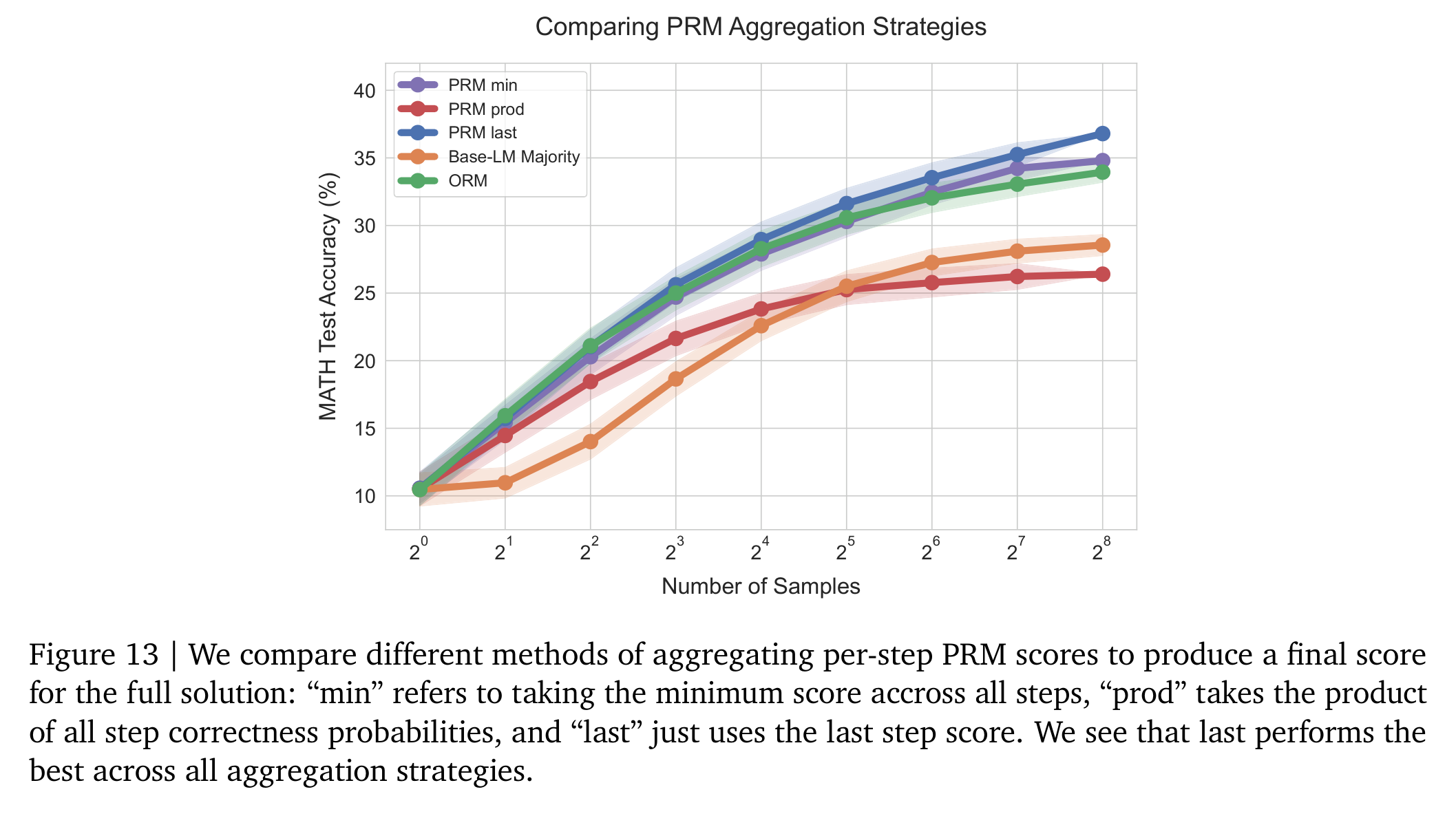
Using the PRM needs two aggregation choices. Step-wise: prior work scored a solution by the minimum or product of its step scores, but here simply taking the last step's prediction worked best (Figure 13). The authors think the soft Monte Carlo labels behave differently from binary correctness labels. Inter-answer: instead of choosing the single top-scoring solution, they use best-of-N weighted, which adds up verifier scores over all solutions that reach the same final answer and returns the answer with the largest total.
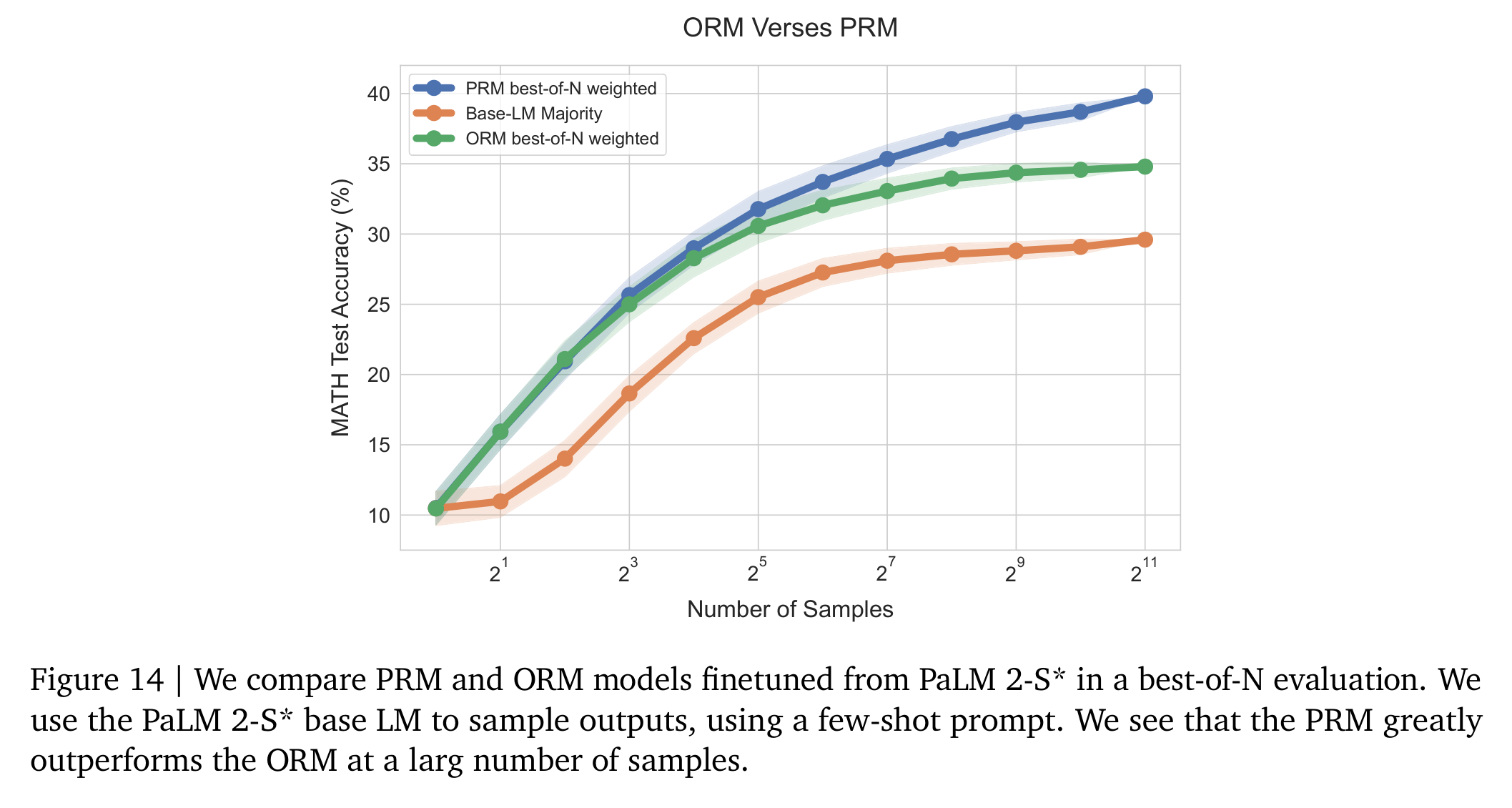
One detail stands out. With last-step scoring the PRM is effectively used like an ORM, yet it still beats an ORM trained the same way, and the gap grows with the number of samples (Figure 14). The authors suggest per-step training may be acting mainly as representation learning.
Key Points
- 1
PRM800k (human labels on GPT-4 solutions) gave a PRM that best-of-N could exploit, probably because of distribution shift to PaLM 2 samples
- 2
Labels come from Monte Carlo rollouts (Math-Shepherd): per-step targets are value estimates of reward-to-go under the base model's policy
- 3
Training data: 16 samples per question, 16 rollouts per step, soft labels with BCE loss, AdamW at lr 3e-5, batch 128, early stopping on a 10% held-out split
- 4
Step-wise aggregation: the last-step score beat min and product (Figure 13), unlike earlier PRM work, which found min best
- 5
Best-of-N weighted: sum verifier scores across solutions that share a final answer and pick the answer with the highest total
- 6
The PRM beats an ORM trained from the same base model, and the gap widens with more samples (Figure 14). All search experiments therefore use the PRM
Mathematical Formulation
PRM Training Loss (soft Monte Carlo labels)
LPRM=−(ylogy^+(1−y)log(1−y^))
y∈[0,1] is the fraction of Monte Carlo rollouts from this step that reach the correct answer, and y^ is the PRM's predicted value for the step. Because y is soft, the PRM learns a reward-to-go value, not a binary is-this-step-valid label.
Best-of-N Weighted Selection
a^=argmaxa∑i=1N1[ans(si)=a]vlast(si)
Each of the N sampled solutions si is scored by the PRM's last-step prediction vlast. Scores are summed per distinct final answer, which combines majority voting with verifier confidence.
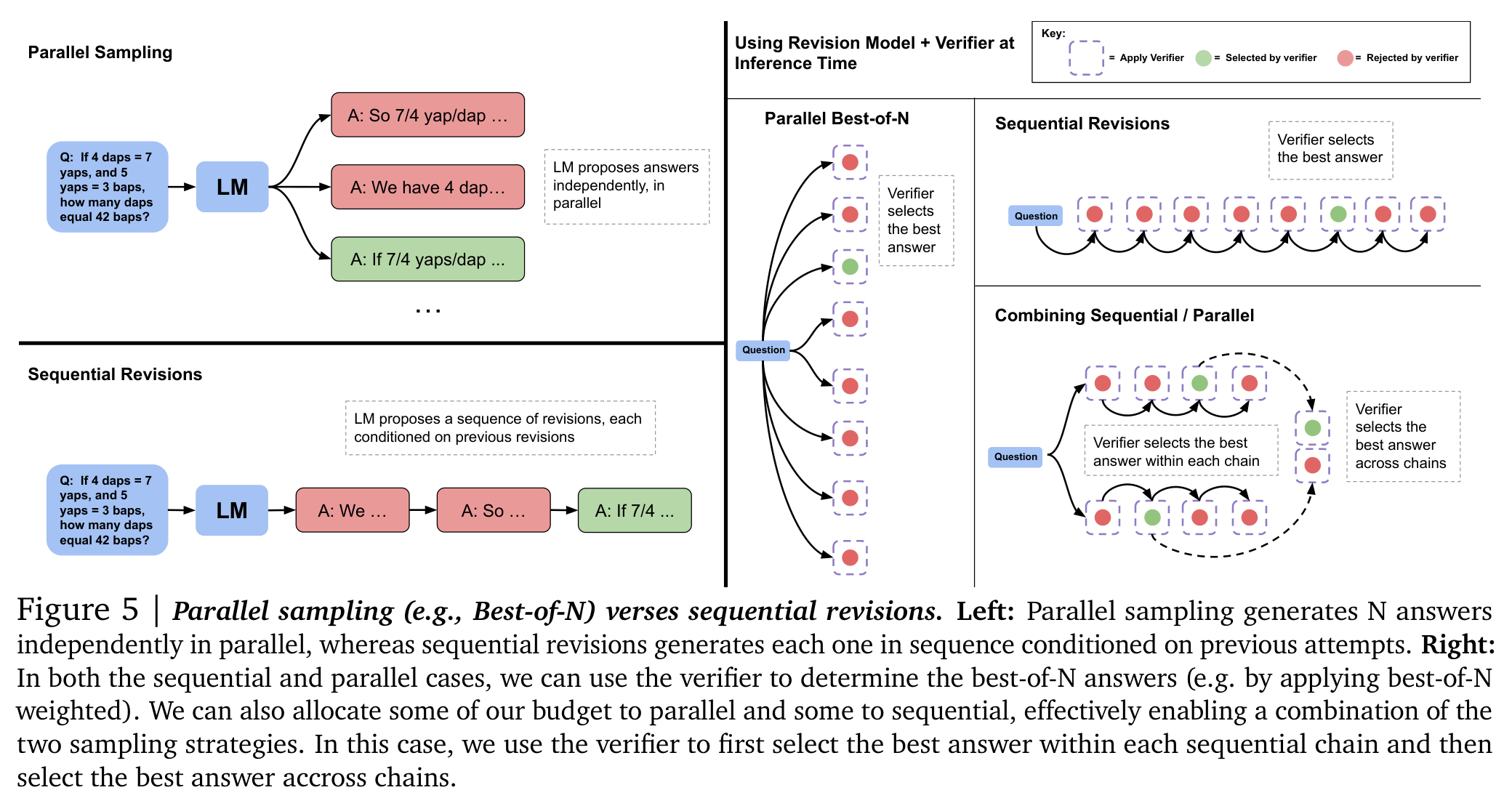
The second axis changes where answers come from. Rather than sampling N independent attempts, the model writes attempts one after another, each conditioned on the ones before, so it can spot and fix its mistakes. Prompting existing LLMs to correct themselves mostly fails on reasoning, so the authors fine-tune PaLM 2-S* into a revision model, building on Qu et al.
The training data has to show the model a run of wrong answers followed by a right one, and the wrong answers should be related to the right one. Otherwise the model learns to ignore its context and start over, which is just parallel sampling with extra steps. Running multi-turn on-policy rollouts was too expensive on their infrastructure, so they build trajectories after the fact: sample 64 answers per question at a higher temperature, then pair each correct answer with 0 to 4 incorrect ones (count drawn uniformly) as context. The incorrect answer placed last is the one closest by character edit distance to the correct target. That is a rough measure of correlation, but it was enough.
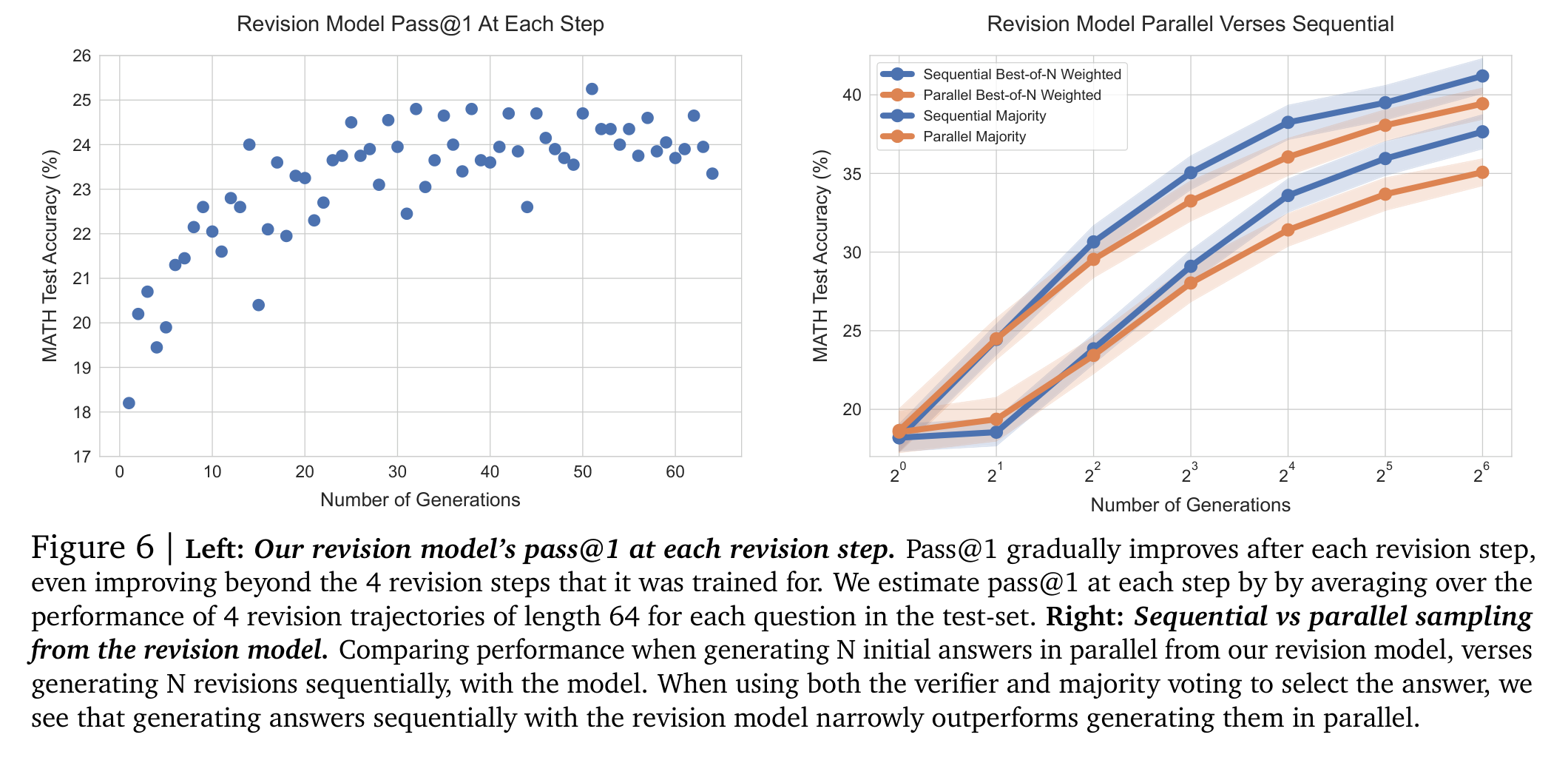
At test time the model was trained on at most four previous answers, so longer chains keep only the four most recent attempts in context. Pass@1 still keeps rising past four revisions (Figure 6, left). There is a catch. Training only ever showed incorrect answers in context, but at test time a correct answer can end up there, and the model may revise it into a wrong one. This happened to about 38% of correct answers. So the final answer is chosen across the chain, by sequential majority voting or by a verifier, not taken from the last revision. The verifier is an ORM trained on the revision model's own outputs, because the PaLM 2 PRM was trained on a different distribution (Appendix J).
With selection in place, a fair comparison at equal budget, N revisions in sequence against N samples in parallel, comes out narrowly in favour of sequential under both majority and verifier selection (Figure 6, right).
Key Points
- 1
A revision model conditions on its earlier attempts and proposes an improved answer. This changes the proposal distribution, not the verifier
- 2
Data: sample 64 answers per question, pair each correct answer with 0 to 4 incorrect ones (drawn uniformly), and place the incorrect answer closest by edit distance last
- 3
Fine-tuned with AdamW at lr 1e-5 and batch 128. The best checkpoint comes after validation loss starts rising, because that validation set is off-policy
- 4
At inference, context is cut to the 4 most recent attempts. Pass@1 still improves past the 4 revisions seen in training
- 5
About 38% of correct answers are revised into wrong ones, so answers are chosen across the chain by majority vote or an ORM verifier
- 6
At equal budget, sequential revisions narrowly beat parallel sampling under both selection methods
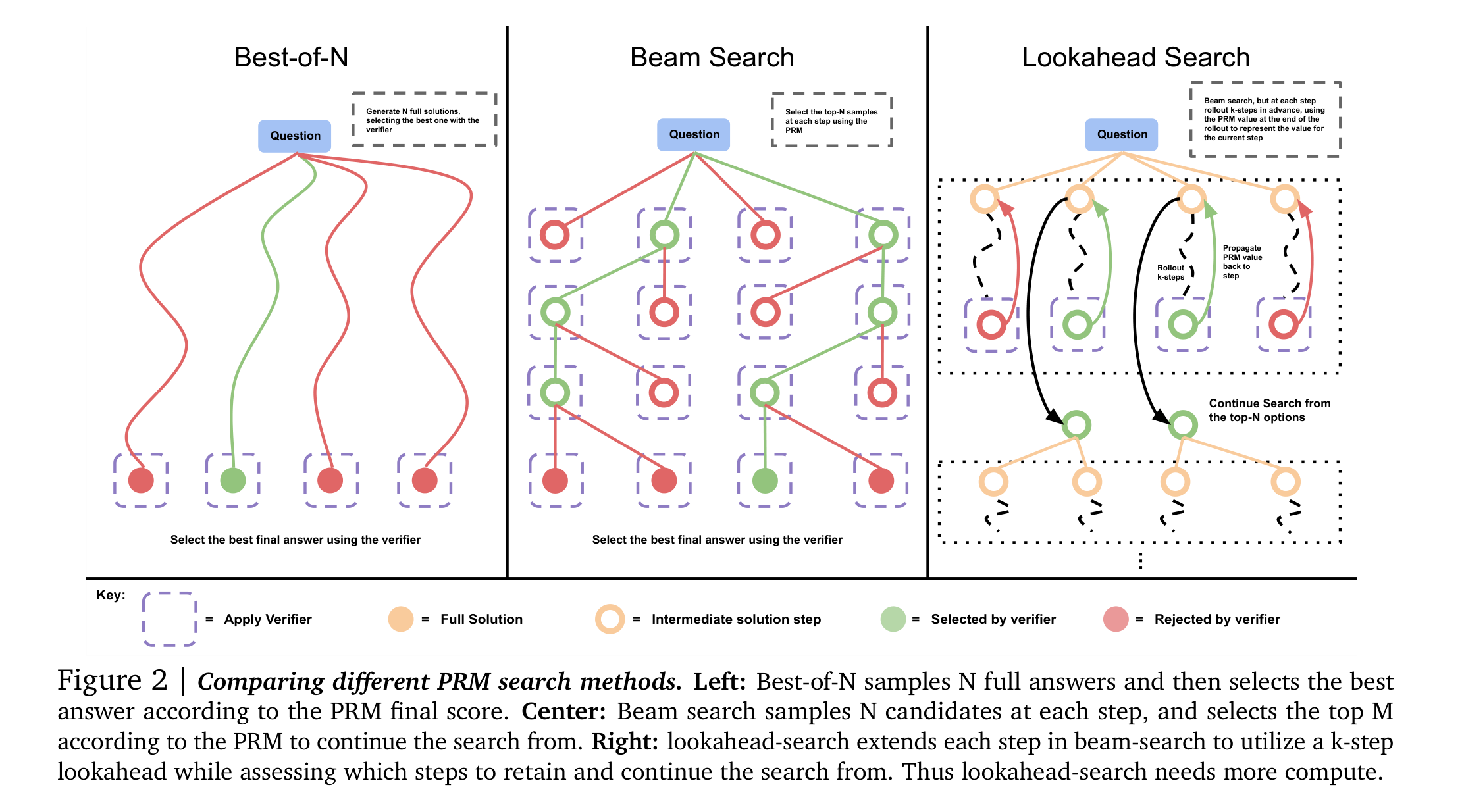
With a working PRM, the next question is how hard to optimize against it. The paper compares three search methods, all sampling from a few-shot prompted base model that writes one step per line (Figure 2).
Best-of-N weighted samples N complete solutions independently and picks an answer with the PRM's final-step score. Beam search works step by step. It samples N candidate first steps, keeps the top N/M by PRM score, samples M continuations from each to get back to N, and repeats, for up to 40 rounds. Best-of-N weighted then picks among the N finished candidates. Lookahead search changes how beam search scores a step. It rolls each candidate k steps further at temperature 0 and uses the PRM's value at the end of that rollout. Beam search is the special case k=0. Lookahead is also MCTS with the randomness taken out. The exploration in MCTS exists to learn a value function, and here the value function (the PRM) is already trained and frozen.
To compare methods at equal cost, a generation is one sampled answer. Best-of-N and beam search cost N. Lookahead costs N(k+1). The sweep, up to a budget of 256, covers beam widths M=N and M=4, lookahead with k=3 at both widths, and k=1 at M=N.
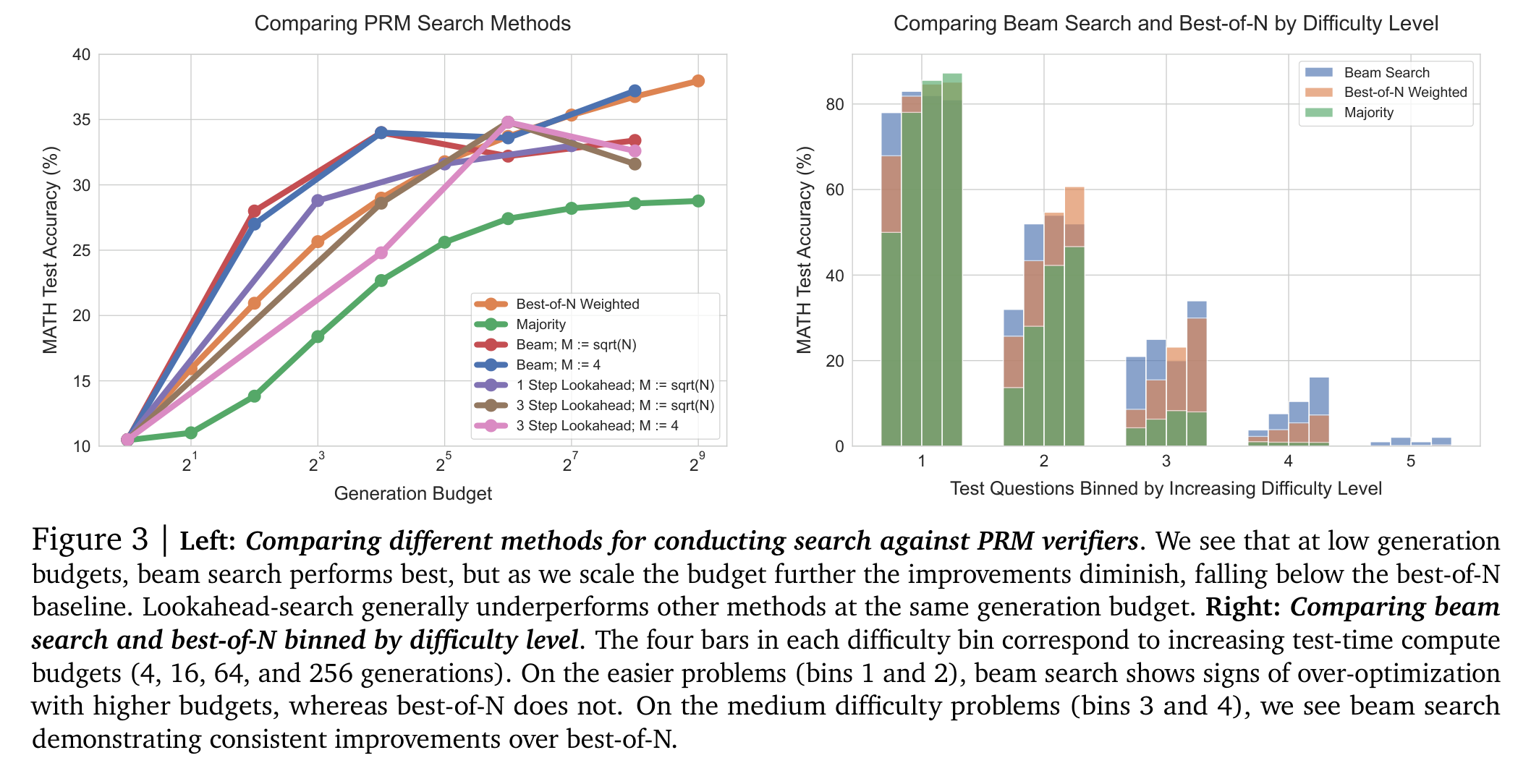
The results in Figure 3 (left) show the problem with strong optimization. At small budgets beam search clearly beats best-of-N. As the budget grows the gap closes, and beam search often falls below best-of-N. Lookahead, the strongest optimizer, does worst. The cause is exploiting the PRM: search produces low-information repeated steps, or solutions just one or two steps long, that the verifier scores highly anyway.
Splitting by difficulty (Figure 3, right) makes the picture clearer. On easy questions (bins 1 to 2) beam search gets worse as the budget grows, because the verifier is mostly right there and more optimization only amplifies its spurious features. On medium questions (bins 3 to 4) beam search consistently beats best-of-N, because the base model rarely samples a correct answer and guidance helps it find one. On bin 5 nothing makes much progress.
Key Points
- 1
Best-of-N weighted: N independent full solutions, then a final answer chosen by summed PRM scores
- 2
Beam search (like BFS-V): keep the top N/M steps by PRM score and expand each into M candidates, for up to 40 rounds
- 3
Lookahead search: score each step by rolling out k more steps at temperature 0. It is beam search with lookahead, and MCTS without the stochastic exploration
- 4
Cost accounting: best-of-N and beam cost N generations. Lookahead costs N(k+1)
- 5
Beam search wins at low budgets but falls behind best-of-N at high budgets. Lookahead generally does worst at equal budget, a sign of PRM exploitation (repetitive or one-to-two-step solutions)
- 6
By difficulty: beam search over-optimizes on easy questions, helps on medium ones, and nothing helps much on the hardest bin
Mathematical Formulation
Beam Search Step
StCt+1=TopN/M(Ct;v)={b⊕x(j):b∈St,x(j)∼π(⋅∣b),j=1,…,M}
From the N current candidates Ct, keep the set St of N/M with the highest PRM value v, then sample M next steps from the base policy π for each survivor. That restores N/M×M=N candidates for the next round.
Lookahead Value and Cost
vlook(st)=v(rolloutT=0(st,k)),cost=N(k+1)
A partial solution st is scored by the PRM's value after a greedy rollout of up to k further steps, stopping early if the solution ends. With k=0 this is beam search. Each step costs k extra samples, so equal-budget comparisons charge lookahead N(k+1).
Sequential revisions beat parallel sampling on average, but the two do different jobs. Parallel sampling is a global search: independent attempts can try completely different high-level approaches. Sequential revision is a local refinement: it improves an answer that is already roughly on track. If both matter, the best use of a budget is probably a mix, for example N chains of N revisions each.
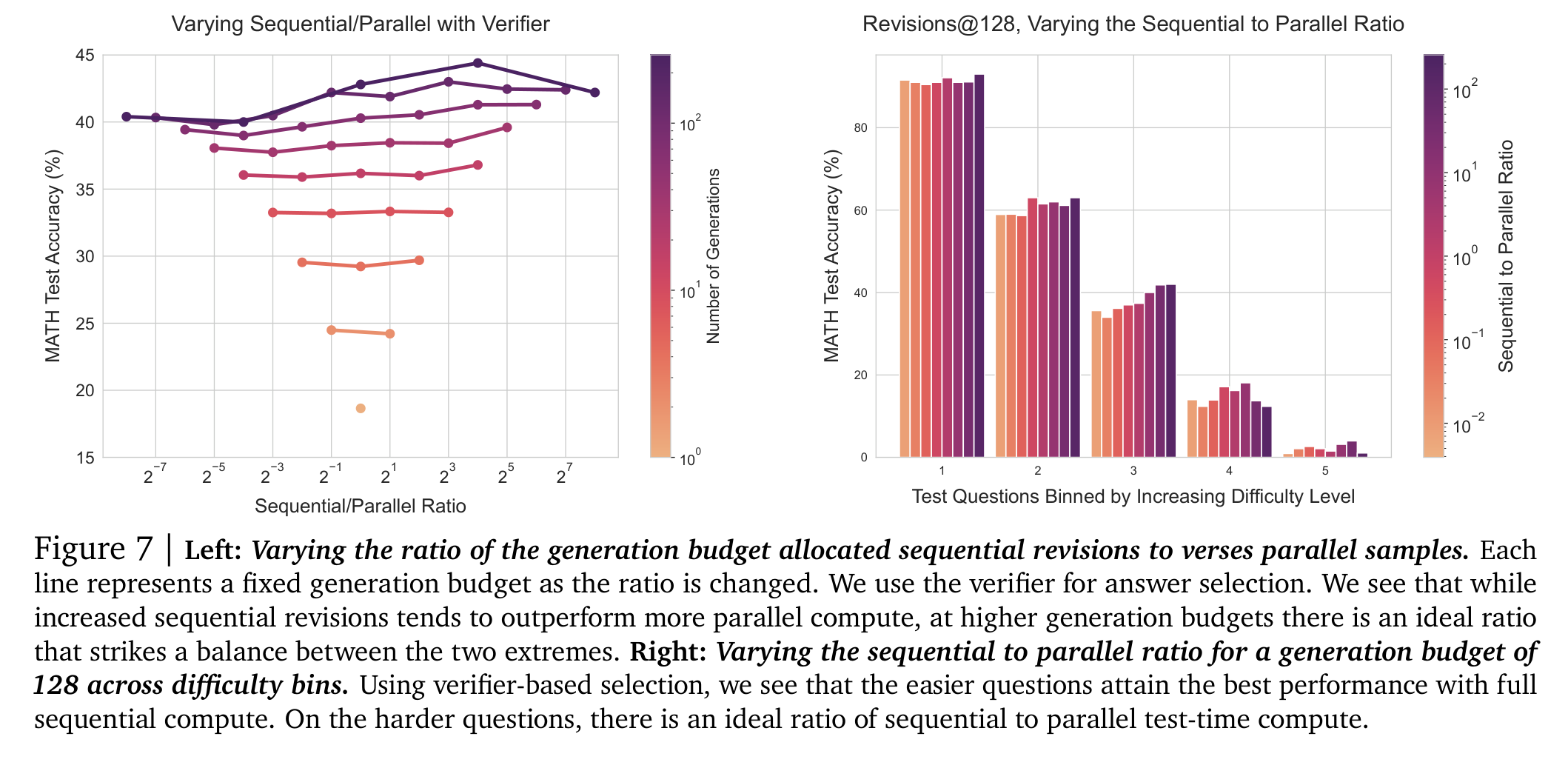
The paper sweeps the sequential-to-parallel ratio at fixed budgets. With a verifier selecting answers (best within each chain, then best across chains, as in Figure 5), Figure 7 (left) shows that more sequential compute usually helps. At larger budgets, though, there is an ideal ratio in between, and accuracy drops off on either side of it.
The ideal ratio depends on the question. At a budget of 128, split by difficulty (Figure 7, right), easy questions do best with purely sequential compute. When the first attempt is close, every extra sample is better spent polishing it. On harder questions there is an interior optimum: some independent attempts are needed to find a viable approach before revising it pays off. This supports the paper's main point. Revisions (the proposer) and parallel sampling with a verifier are complementary axes, and how to split compute between them is a per-prompt decision.
Key Points
- 1
Parallel = global search over different high-level approaches. Sequential = local refinement of an answer that is already on track
- 2
Combined allocation: run several revision chains, pick the best answer within each chain with the verifier, then the best across chains
- 3
At a fixed budget, more sequential compute usually wins, but at higher budgets there is an ideal ratio between the extremes (Figure 7, left)
- 4
At budget 128: easy questions do best with fully sequential compute. Harder questions peak at an intermediate ratio (Figure 7, right)
- 5
This supports treating the proposer and the verifier as complementary axes for scaling test-time compute
Mathematical Formulation
Splitting a Generation Budget
N=Npar×Nseq,ρ=NparNseq
Npar independent chains, each with Nseq revisions. ρ→N is fully sequential and ρ→1/N is plain best-of-N. A balanced split such as Npar=Nseq=N is the starting point, and the best ρ is chosen per difficulty bin.
Put the pieces together: bin each question by difficulty, then use whichever configuration won on that bin at the current budget. The paper does this separately for both axes, and both show the same pattern.
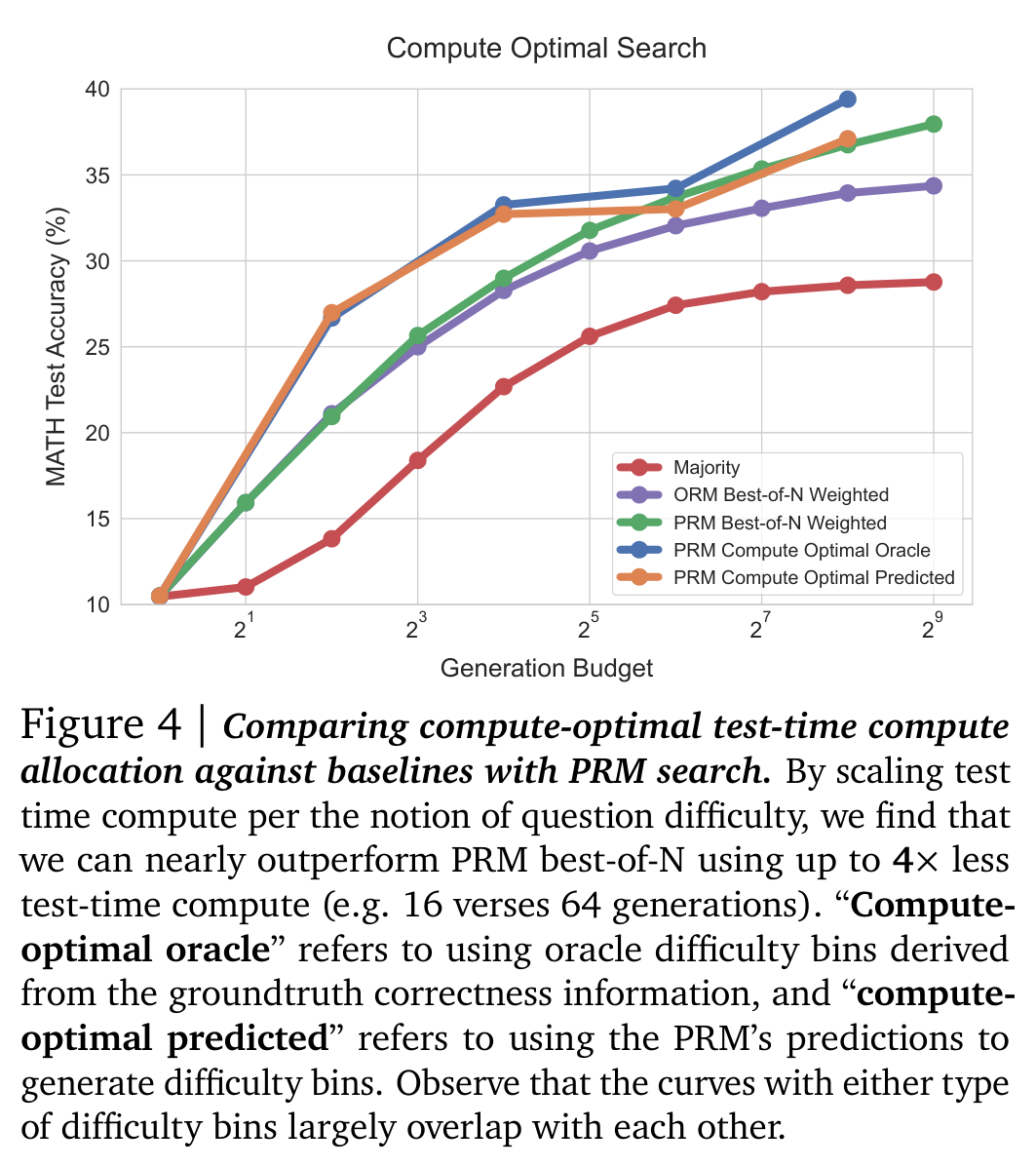
PRM search (Figure 4). At low budgets, compute-optimal search nearly beats PRM best-of-N while using up to 4x less test-time compute, for example 16 generations against 64. At higher budgets some of the advantage fades when difficulty is predicted, while oracle bins keep improving. The oracle and predicted curves mostly overlap, which suggests the practical verifier-based binning gives up little.
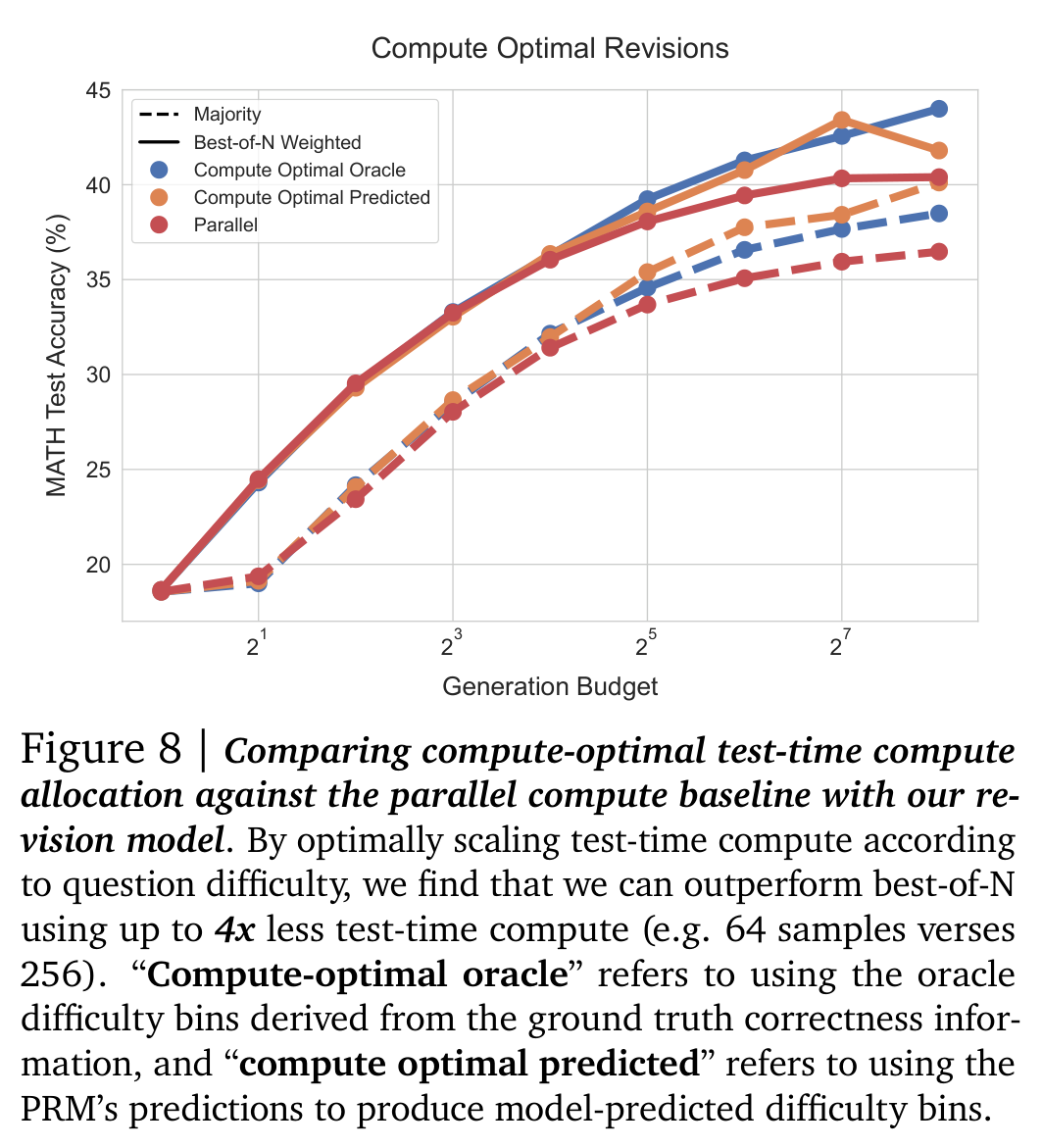
Revisions (Figure 8). Choosing the sequential-to-parallel ratio per bin beats parallel best-of-N with up to 4x less compute, for example 64 samples against 256. Parallel sampling levels off at high budgets, while the compute-optimal curve keeps rising, with either oracle or predicted bins.
Overall, in the discussion's terms, compute-optimal scaling makes test-time compute 2 to 4x more efficient. Neither the search methods nor the revision model are new here. The gain comes entirely from spending the same compute differently on different prompts. One caveat applies to the numbers: they do not include the compute needed to estimate difficulty.
Key Points
- 1
PRM search: compute-optimal allocation nearly beats PRM best-of-N with up to 4x less compute (16 vs 64 generations)
- 2
Revisions: compute-optimal allocation beats parallel best-of-N with up to 4x less compute (64 vs 256 samples)
- 3
With revisions, parallel sampling plateaus at high budgets while compute-optimal scaling keeps improving
- 4
Oracle and predicted difficulty curves largely overlap, so verifier-predicted bins capture most of the gain
- 5
The discussion puts the overall efficiency gain at 2 to 4x, from allocation alone, with no new model or search algorithm
- 6
Caveat: the compute used to estimate difficulty is not charged to the compute-optimal curves
Mathematical Formulation
The Efficiency Claim
compute-optimal16vsPRM best-of-N64,compute-optimal64vsparallel best-of-N256
The two 4x comparisons the paper quotes: generations needed by the compute-optimal policy against the best-of-N baseline at matching or near-matching MATH accuracy, for PRM search (Figure 4) and revisions (Figure 8).
The title's claim is tested here. Suppose a model was pretrained with X FLOPs and will serve Y FLOPs of inference. You can multiply the total budget by M, to M(X+Y). Should the extra FLOPs go into a bigger model or into more test-time compute for the small one? The paper scales pretraining by adding parameters with the data fixed, as in the LLaMA series, and leaves Chinchilla-style joint scaling to future work.
The exchange rate uses the standard approximations: pretraining costs X=6NDpretrain and inference costs Y=2NDinference, where N here means parameter count. Multiplying parameters by M multiplies both terms by M, since the bigger model is also more expensive to serve. To match that with the small model, its inference budget can grow by a factor of M+3(Dpretrain/Dinference)(M−1). The answer depends on R=Dinference/Dpretrain. Large production deployments may have R≫1. Self-improvement pipelines, which generate relatively few tokens, have R≪1.
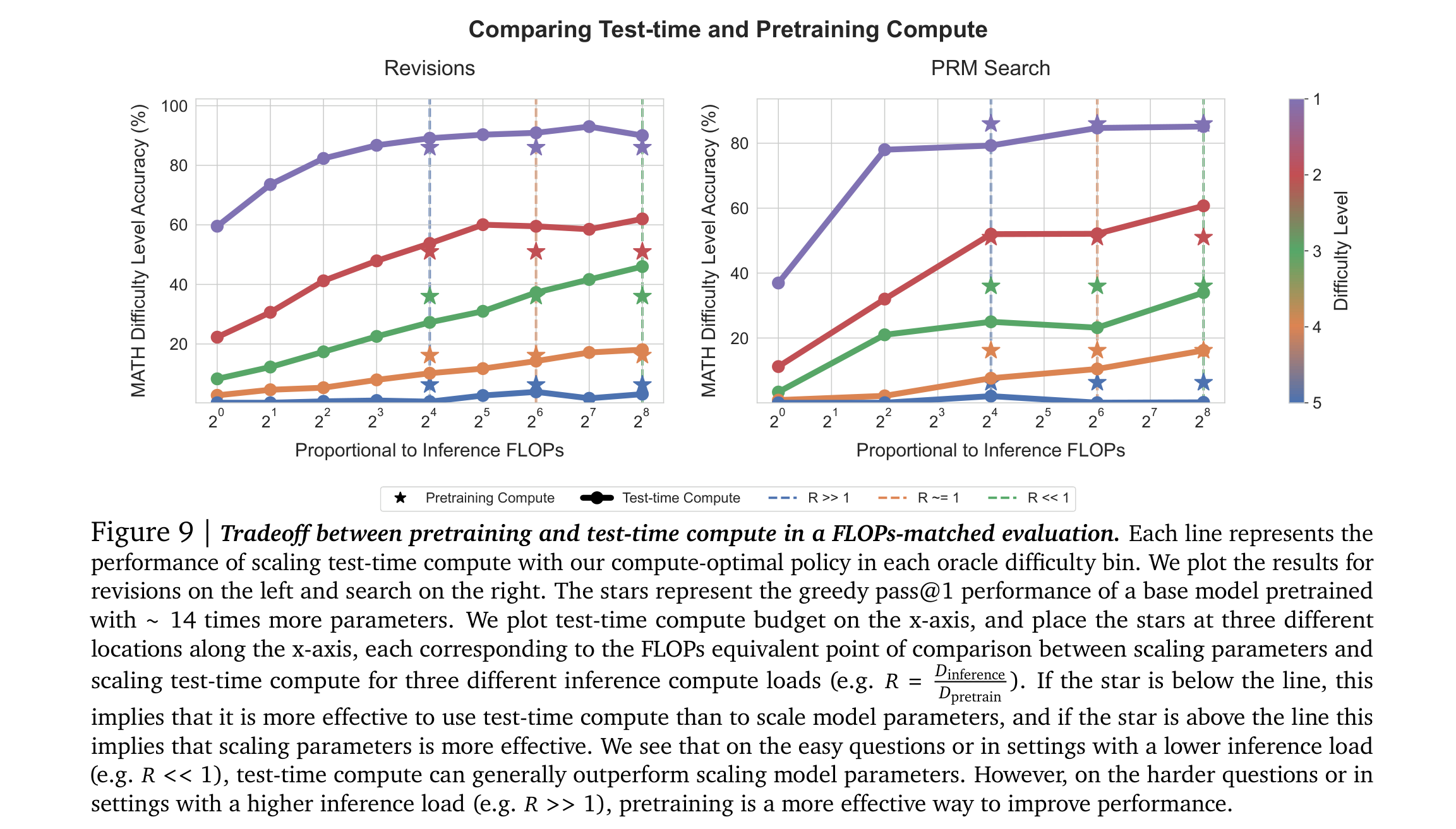
Figure 9 runs the comparison against a model with ~14x more parameters, at R = 0.16, 0.79 and 22. Stars mark the larger model's greedy accuracy. Where a star sits below the small model's test-time compute curve, test-time compute was the better use of the FLOPs. On easy and intermediate questions (bins 1 to 3, sometimes 4), or when inference requirements are low, test-time compute wins. On the hardest questions (bins 4 to 5), or at large R, pretraining wins.
Figure 1's bars give the size of the effect. With revisions at R≪1, test-time compute improves on the larger model by +21.6% / +27.8% / +11.8% (easy / medium / hard). At R≫1 the figures are +5.4% / −24.3% / −37.2%. PRM search follows the same pattern more sharply: +19.1% on easy questions at R≪1, and −52.9% on hard questions at R≫1. The conclusion is limited and still notable. Even with fairly simple methods, test-time compute can already be preferable to scaling parameters, but it does not substitute one-for-one for pretraining on questions beyond the model's reach.
Key Points
- 1
Setup: total FLOPs grow from X+Y to M(X+Y). Spend them on ~14x more parameters (data fixed) or on test-time compute for the small model?
- 2
FLOPs model: pretraining X=6NDpretrain, inference Y=2NDinference, with N = parameters
- 3
Matching the larger model lets the small model scale inference by M+3(M−1)/R, where R=Dinference/Dpretrain
- 4
Tested at R = 0.16, 0.79, 22. Easy and medium questions or low inference load favour test-time compute. Hard questions or high load favour pretraining
- 5
Revisions, from Figure 1: +21.6 / +27.8 / +11.8% (easy / medium / hard) at R≪1, and +5.4 / −24.3 / −37.2% at R≫1
- 6
PRM search: +19.1% (easy, R≪1) down to −52.9% (hard, R≫1)
- 7
Takeaway: test-time and pretraining compute are not 1-to-1 exchangeable. Test-time compute covers for parameters only within the model's capabilities
Mathematical Formulation
Pretraining and Inference FLOPs
X=6NDpretrain,Y=2NDinference,R=DpretrainDinference
N is the parameter count here, not the generation budget. Scaling N by M multiplies both X and Y by M. R measures how inference-heavy the deployment is.
Test-Time Budget That Matches an M-times Larger Model
YY′=M+3DinferenceDpretrain(M−1)=M+R3(M−1)
This follows from X+Y′=M(X+Y). With M=14 the factor is about 258 at R=0.16, about 63 at R=0.79 and about 16 at R=22, which is why the comparison points in Figure 9 move left as R grows.
The paper names its gaps clearly, and several of them became research directions.
Hard problems stay hard. Across search and revisions alike, the hardest difficulty bin barely improved. When the base model almost never samples a correct answer, neither a verifier nor a revision chain has much to work with. The authors call for new ways of using test-time compute that get around this. Until then, the FLOPs-matched results say these are the questions where pretraining still pays.
Difficulty is not free. The compute-optimal policy needs a difficulty estimate, which here came from 2048 samples per question scored by the verifier. That is a lot of test-time compute in its own right, and the reported curves do not charge for it. The authors suggest models that predict difficulty directly, or policies that switch between assessing and solving as they go.
The axes were not fully combined. Revisions were paired with an ORM verifier, but PRM tree search was never combined with revisions, and techniques such as critique-and-revise were not studied. Capabilities were fine-tuned in. Both the PRM and the revision model needed task-specific fine-tuning on MATH. The authors expect future models to be pretrained with these abilities. Pretraining was scaled one way only. Parameters grew and data stayed fixed, so the comparison with compute-optimal pretraining remains open.
The longest-term idea is to close the loop: distil the outputs of test-time compute back into the base model, so that thinking longer at inference becomes a way to train. The paper ends with a prediction: in future, fewer FLOPs will go into pretraining and more into inference.
Key Points
- 1
Small gains on the hardest problems for every method studied. New test-time techniques are needed there
- 2
Difficulty estimation is expensive (2048 samples) and uncharged in the experiments. Direct difficulty prediction is proposed as future work
- 3
PRM tree search plus revisions and critique-and-revise were not explored
- 4
Both capabilities required capability-specific fine-tuning. The authors expect future pretrained models to have them built in
- 5
Pretraining was scaled by parameters with data fixed, so the comparison with Chinchilla-style compute-optimal pretraining is open
- 6
Future direction: distil test-time outputs back into the base model for an iterative self-improvement loop
Keep reading
Related Papers
Go deeper