Qwen2-VL
Enhancing Vision-Language Model's Perception of the World at Any Resolution
Peng Wang, Shuai Bai, Sinan Tan, Shijie Wang, Zhihao Fan, Jinze Bai,
9
Concepts
6
Formulas
12
Figures
5
Demos
Paper Overview
Qwen2-VL (Qwen Team, Alibaba Group, 2024) asks a plain question: why should a vision-language model look at every image through the same keyhole? Most LVLMs of the time resized each input to a fixed size such as 224×224, or scaled and padded it, before the vision encoder ever saw it. A receipt, a 1092×8204 web page and a thumbnail all came out as the same number of tokens, and fine text in large images was simply lost.
The paper keeps the Qwen-VL framework (vision encoder, connector, LLM) and makes three changes. Naive Dynamic Resolution lets the 675M-parameter ViT take images at native resolution and emit a variable number of tokens: one LLM token per 28×28 pixel block, so a 224×224 image costs 66 tokens and a long web page costs over eleven thousand. Multimodal Rotary Position Embedding (M-RoPE) splits rotary position into temporal, height and width components, so one positional scheme covers text, images and video. A unified image/video pipeline samples video at 2 fps and runs a depth-2 3D convolution, so frames are encoded as tubes and an image is just a two-frame video.
Training follows Qwen-VL's three stages over 1.4T pre-training tokens, and the open-weight family comes in 2B, 7B (8B total) and 72B sizes. Qwen2-VL-72B reaches 96.5 on DocVQA, 877 on OCRBench and 77.8 on RealWorldQA, ahead of GPT-4o and Claude 3.5 Sonnet on most document and general-VQA benchmarks. The paper is also candid about where it trails: 64.5 vs GPT-4o's 69.1 on MMMU, and far behind specialist models on vision-language navigation.
Chapter Roadmap
Click any topic to jump in
The Fixed-Resolution Bottleneck
Most LVLMs squash every image to one size such as 224×224, losing detail in large images and treating video as a separate modality.
Architecture and Model Family
One 675M ViT shared across Qwen2 LLMs of 1.5B, 7.6B and 72B parameters, keeping vision cost constant as the LLM grows.
Three architectural changes
Naive Dynamic Resolution
Images enter at native resolution; 2D-RoPE replaces absolute positions and a 2×2 MLP merge gives one LLM token per 28×28 pixels.
M-RoPE
Rotary embedding split into temporal, height and width components, so text, images and video share one positional scheme.
Unified Image and Video
Video at 2 fps through a depth-2 3D convolution; images are two identical frames; at most 16,384 tokens per video.
Three-Stage Training
ViT-only, then everything, then LLM-only instruction tuning: 1.4T pre-training tokens with loss on text tokens only.
Perception and action
Results
72B scores 96.5 DocVQA, 877 OCRBench and 77.8 RealWorldQA, ahead of GPT-4o on documents, though behind it on MMMU (64.5 vs 69.1).
The Visual Agent
Function calls, phone UI, card games, ALFRED and navigation: 72.1 exact match on AITZ against GPT-4o’s 35.3.
Scaling and Limits
Math improves with model size, OCR is strong even at 2B, and navigation remains far behind specialist models.
Concept by concept
9 sections, in reading order.
The standard LVLM recipe of 2023 was visual encoder → cross-modal connector → LLM, trained with next-token prediction. It worked, but it carried an assumption from image classification: every image is first forced to one resolution. Models either down- or up-sampled to something like 224×224, or used a scale-then-pad approach. That is convenient for batching and disastrous for detail. A dense document page shrunk to 224 pixels wide no longer has legible characters, and no amount of LLM capacity can recover information the encoder never received.
The paper names two more problems. First, many LVLMs keep a frozen CLIP-style encoder, so the visual representation cannot adapt to OCR, charts, or fine-grained reasoning. Qwen-VL had already shown that fine-tuning the ViT helps; Qwen2-VL keeps it trainable and adds dynamic resolution on top. Second, video is usually bolted on as a separate modality, and positions are encoded one-dimensionally. Text is a 1D sequence, but an image is 2D and a video is 3D. Flattening them into a single running index throws away which tokens are neighbours in space or time.
Qwen2-VL's thesis is that perception should scale with the input: more pixels should mean more tokens, and position should carry the input's true geometry. A small icon should be cheap, a 20-minute video should still fit, and the model should know that two patches are vertically adjacent rather than 40 positions apart.
Key Points
- 1
Standard LVLMs encode inputs at a fixed resolution (e.g. 224×224) by resizing, or with a scale-then-padding approach
- 2
One-size-fits-all resolution causes significant loss of detail in high-resolution images, such as documents, charts and screenshots
- 3
Many LVLMs use a static, frozen CLIP-style encoder, which raises doubts about whether its features are adequate for fine-grained reasoning
- 4
Video is often treated as an independent modality, and 1D position embeddings cannot express 2D layout or temporal order
- 5
Scaling laws for LVLMs, meaning how performance changes with model and data size, were still largely unexplored
- 6
Qwen2-VL's answer: native-resolution input, a trainable ViT with 2D-RoPE, M-RoPE in the LLM, and one pipeline for images and video
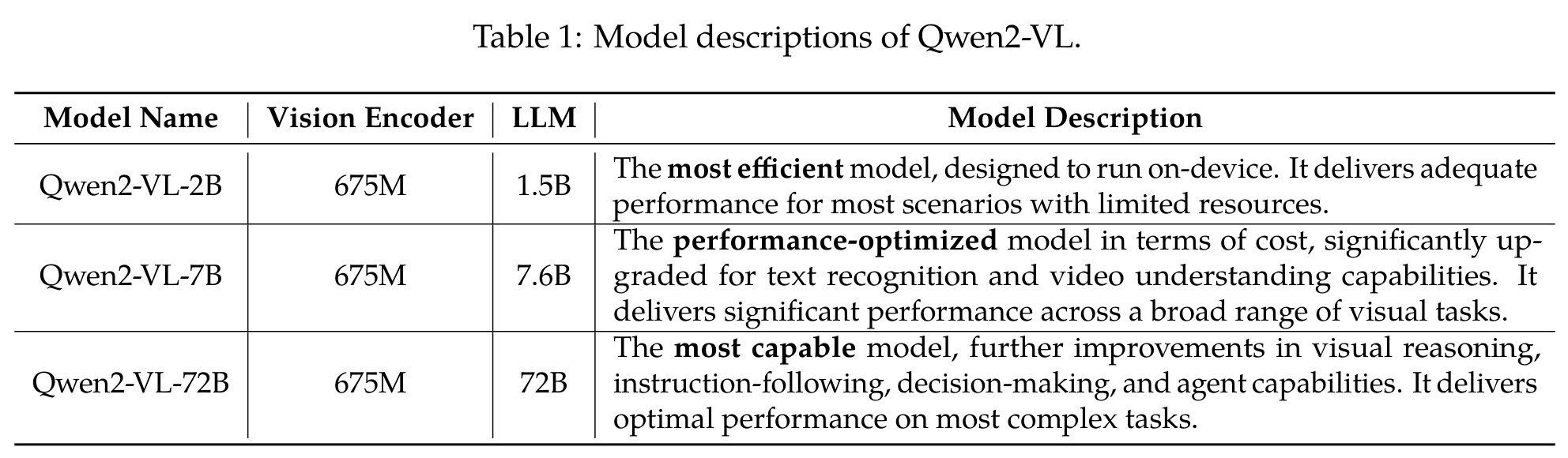
Qwen2-VL keeps the Qwen-VL layout: a Vision Transformer feeds a language model. The language side is upgraded to the Qwen2 LLM series. The vision side is a single ViT of about 675M parameters, initialised from the DFN ViT but with its fixed absolute position embedding replaced by 2D-RoPE.
The notable design choice is that the ViT does not grow with the model. All three sizes share the same 675M encoder, paired with a 1.5B, 7.6B or 72B LLM. As the paper puts it, this keeps the computational load of the ViT constant regardless of LLM scale. Vision cost therefore depends on how many pixels you send, not on which model you chose. That is the property Naive Dynamic Resolution builds on.
Between the two sits a deliberately simple connector: an MLP that merges each 2×2 neighbourhood of ViT tokens into one token, with <|vision_start|> and <|vision_end|> marking the visual span. There is no Q-Former and no fixed query budget. The number of visual tokens is set by the image, not by the architecture.
Key Points
- 1
Qwen2-VL-2B: 675M ViT + 1.5B LLM. The on-device model
- 2
Qwen2-VL-7B: 675M ViT + 7.6B LLM. Upgraded for text recognition and video; about 8B parameters in total
- 3
Qwen2-VL-72B: 675M ViT + 72B LLM. Strongest at visual reasoning, instruction following and agent tasks
- 4
The same ViT at every scale keeps vision compute independent of LLM size
- 5
ViT initialised from DFN, with its absolute position embedding replaced by 2D-RoPE; LLM initialised from Qwen2
- 6
Connector: an MLP compressing adjacent 2×2 tokens into one, wrapped in <|vision_start|> / <|vision_end|> special tokens
- 7
All three models are released as open weights
The core change sounds almost too simple: stop resizing. Qwen2-VL feeds each image to the ViT at (close to) its native resolution and lets the token count follow the pixel count. The idea, credited to NaViT (Patch n' Pack), had already shipped in the internal Qwen-VL Plus and Max models; Qwen2-VL brings it to the open release.
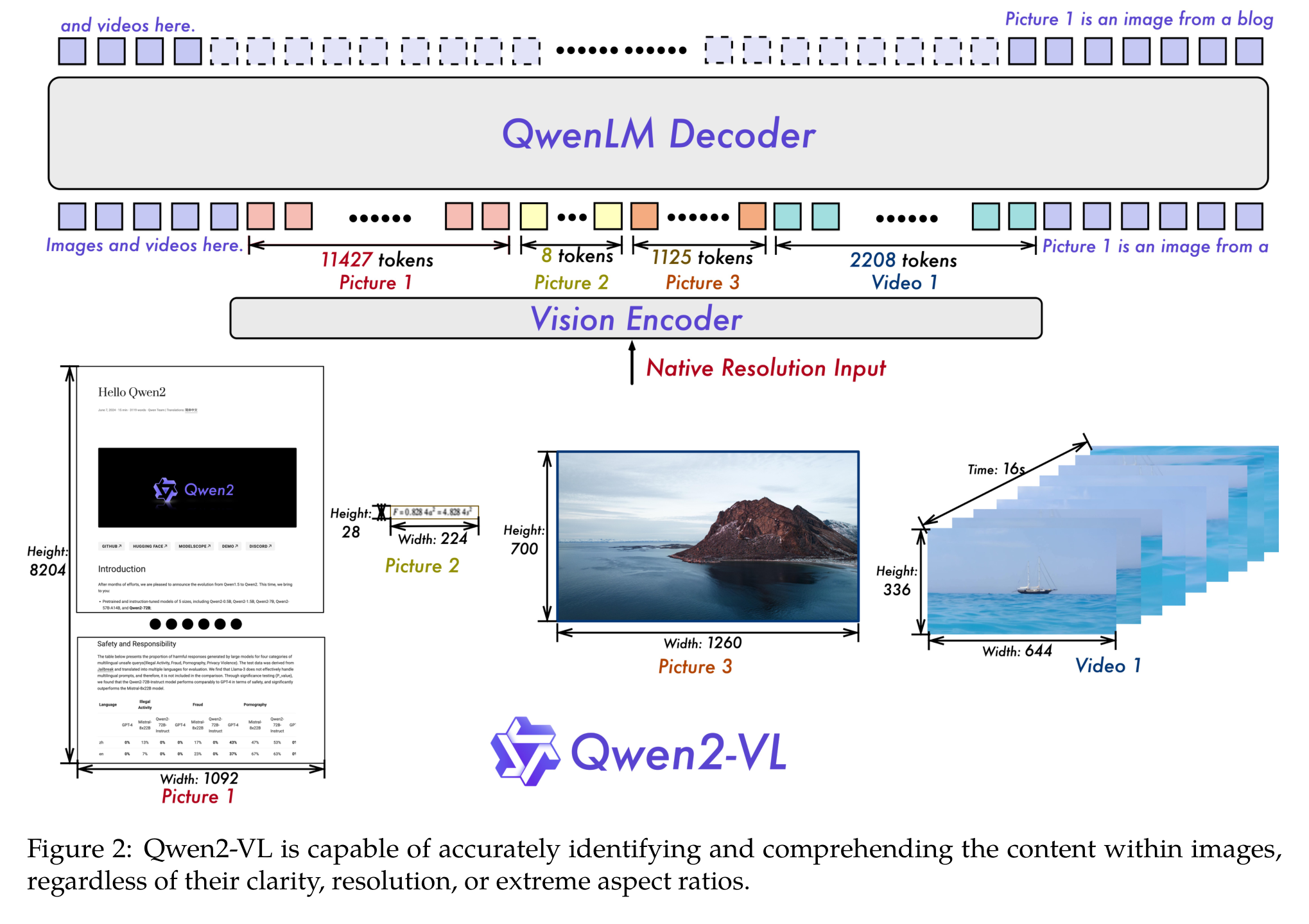
Two things have to change for this to work. First, a ViT with learned absolute position embeddings has a fixed grid baked in, so the paper removes them and uses 2D-RoPE. Rotary position is a function of relative offsets in height and width, so it is defined for any grid size. Second, the token count can get large, so after the ViT (patch size 14) an MLP merges each 2×2 block of tokens into one. The net rate is one LLM token per 28×28 pixel block. That gives the paper's worked example: a 224×224 image becomes 8×8=64 tokens, plus <|vision_start|> and <|vision_end|>, for 66 tokens in total. The images in Figure 2 show the range: a 224×28 formula strip costs 8 tokens, a 1260×700 photo costs 1,125, and a 1092×8204 web page costs 11,427.
Variable-length images are awkward to batch, so at inference images of different resolutions are packed into a single sequence, with the packed length capped to bound GPU memory. For evaluation the paper bounds the token count per image with min_pixels =100×28×28 and max_pixels =16384×28×28, i.e. between 100 and 16,384 tokens.
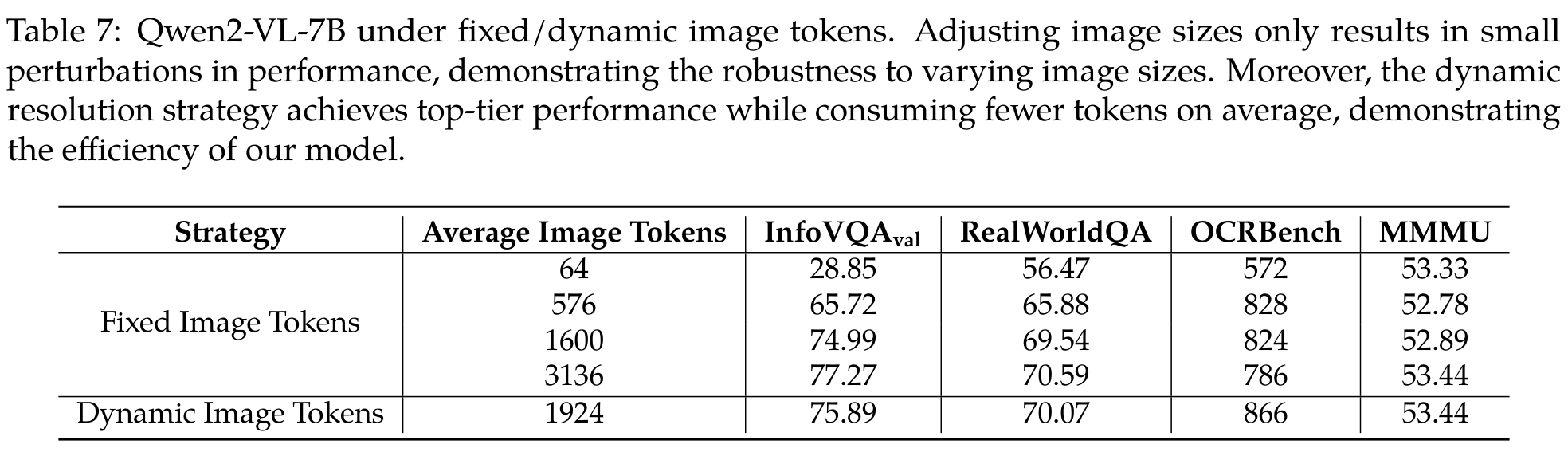
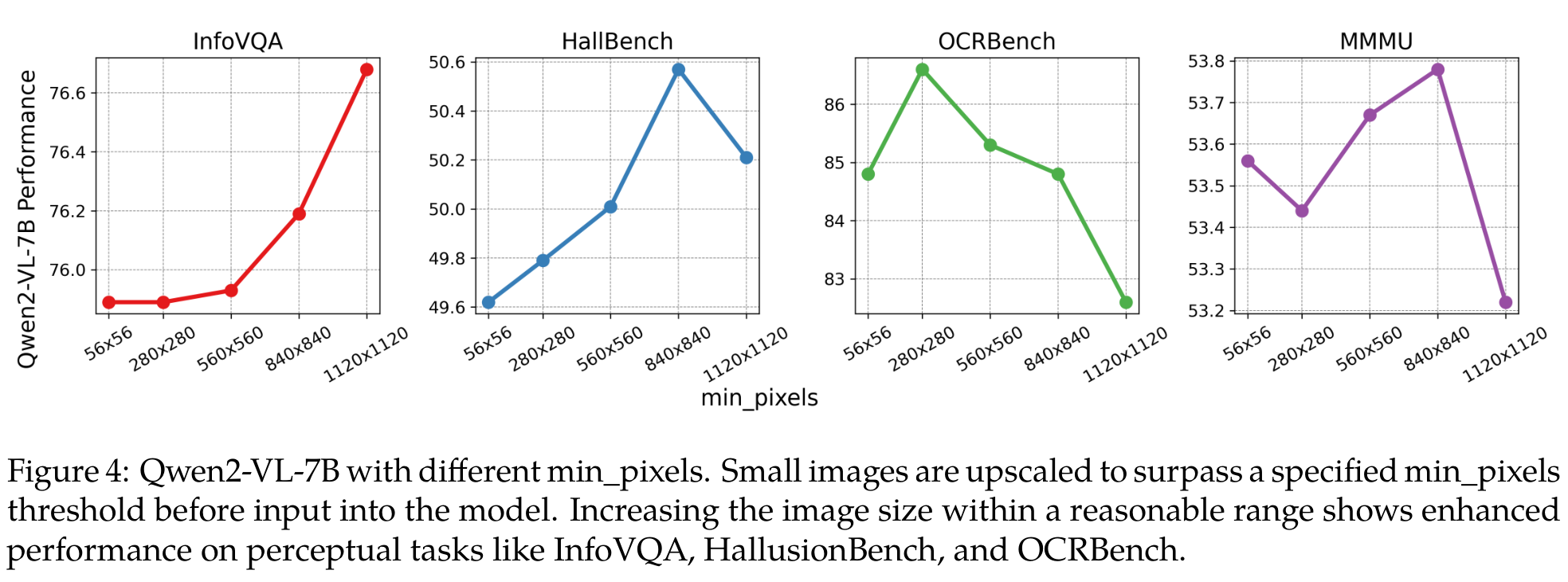
The ablation (Table 7) shows why this beats picking one good fixed size. Qwen2-VL-7B with a fixed 64 tokens collapses on InfoVQA (28.85). At 3,136 fixed tokens it does best on InfoVQA (77.27) but falls back on OCRBench (786). Dynamic resolution averages 1,924 tokens and is near the top everywhere, with 866 on OCRBench, the best of any setting. No single fixed resolution is optimal across benchmarks. Figure 4 adds a caveat: raising min_pixels to upscale small images helps perceptual tasks, but too high a value hurts OCRBench, whose many tiny images become out-of-distribution when blown up.
Key Points
- 1
Images of any resolution become a variable number of visual tokens; there is no fixed square input
- 2
The ViT's absolute position embeddings are removed and replaced by 2D-RoPE, which works for any height × width grid
- 3
ViT patch size 14; an MLP merges adjacent 2×2 tokens, so one LLM token covers a 28×28 pixel block
- 4
Worked example from the paper: 224×224 → 66 tokens, i.e. 64 visual tokens plus the two vision start/end tokens
- 5
At inference, images of different resolutions are packed into one sequence with a capped length to bound GPU memory
- 6
Table 7 (Qwen2-VL-7B): dynamic resolution uses 1,924 tokens on average and gets 75.89 InfoVQA / 70.07 RealWorldQA / 866 OCRBench / 53.44 MMMU
- 7
Fixed 64 tokens gives only 28.85 on InfoVQA; fixed 3,136 tokens gets 77.27 on InfoVQA but only 786 on OCRBench
- 8
Figure 4: upscaling small images helps InfoVQA, HallusionBench and OCRBench up to a point, but too high a min_pixels hurts OCRBench and barely moves MMMU
Mathematical Formulation
Visual tokens for an image
Nimg=28H⋅28W+2
Patch size 14 sets the ViT grid, and the 2×2 MLP merge halves each side, so one token covers 28=14×2 pixels per side. The +2 is the <|vision_start|>/<|vision_end|> pair. For H=W=224: 8⋅8+2=66, the number reported in the paper.
Evaluation token bounds
100≤282H⋅W≤16384
The only constraint used in the dynamic-resolution ablation: min_pixels =100×28×28 and max_pixels =16384×28×28, so each image gets between 100 and 16,384 merged tokens and the count otherwise follows its native resolution.
Once images arrive at their own resolution, the LLM also needs to know where each visual token came from. Standard 1D RoPE gives every token one integer position. Flattening an image row by row makes vertically adjacent patches look a full row width apart. For video, frame boundaries disappear into one long count.
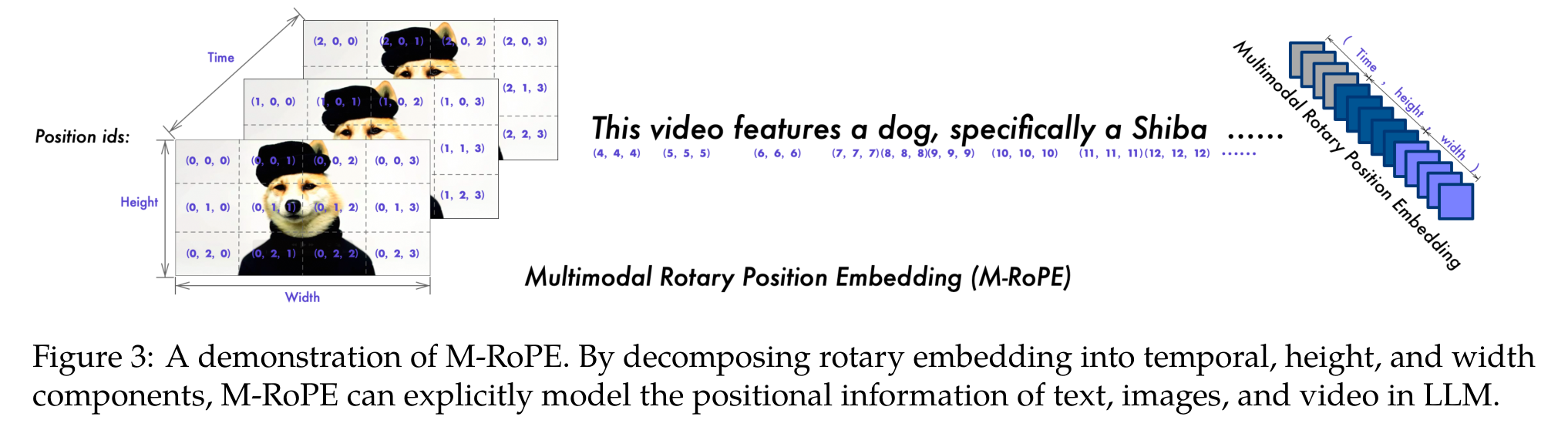
M-RoPE decomposes the rotary embedding into three components: temporal, height and width. Each token gets a position triple (t,h,w), and each component drives its own share of the rotary dimensions. The assignment rules are simple:
- Text: all three components use the same ID, so M-RoPE is functionally identical to 1D RoPE. A language-only prompt behaves exactly as it did in Qwen2.
- Images: the temporal ID is constant across the image; height and width IDs follow the token's row and column.
- Video: the temporal ID increments per frame, and height/width follow the same pattern as images.
- Mixed input: each modality's numbering starts at the previous modality's maximum ID plus one.
In Figure 3, the video's grid IDs reach at most 3, so the caption 'This video features…' resumes at (4,4,4). That illustrates a less obvious benefit the paper highlights: M-RoPE reduces the position ID values for images and video. A 1,000-token image does not consume 1,000 positions, only about as many as its longest side. Smaller IDs are what let the model extrapolate to longer sequences at inference.
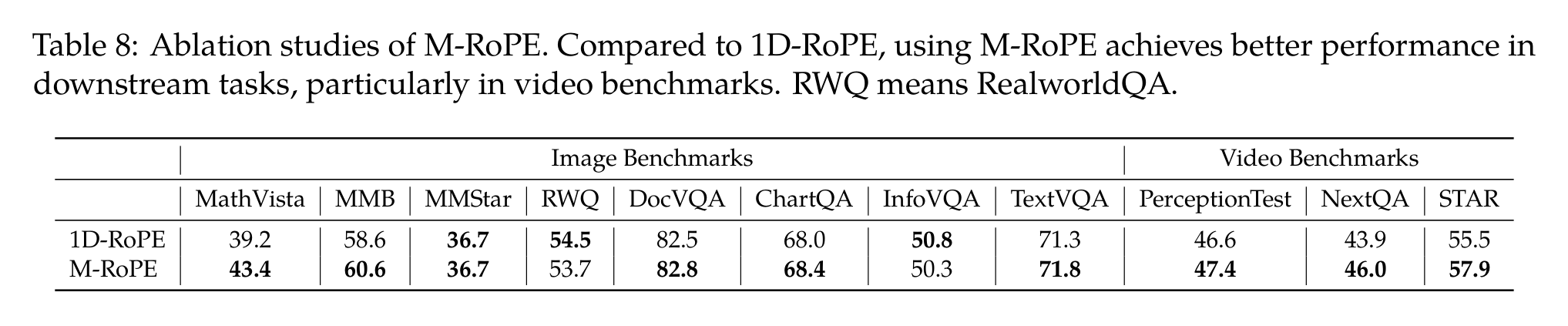
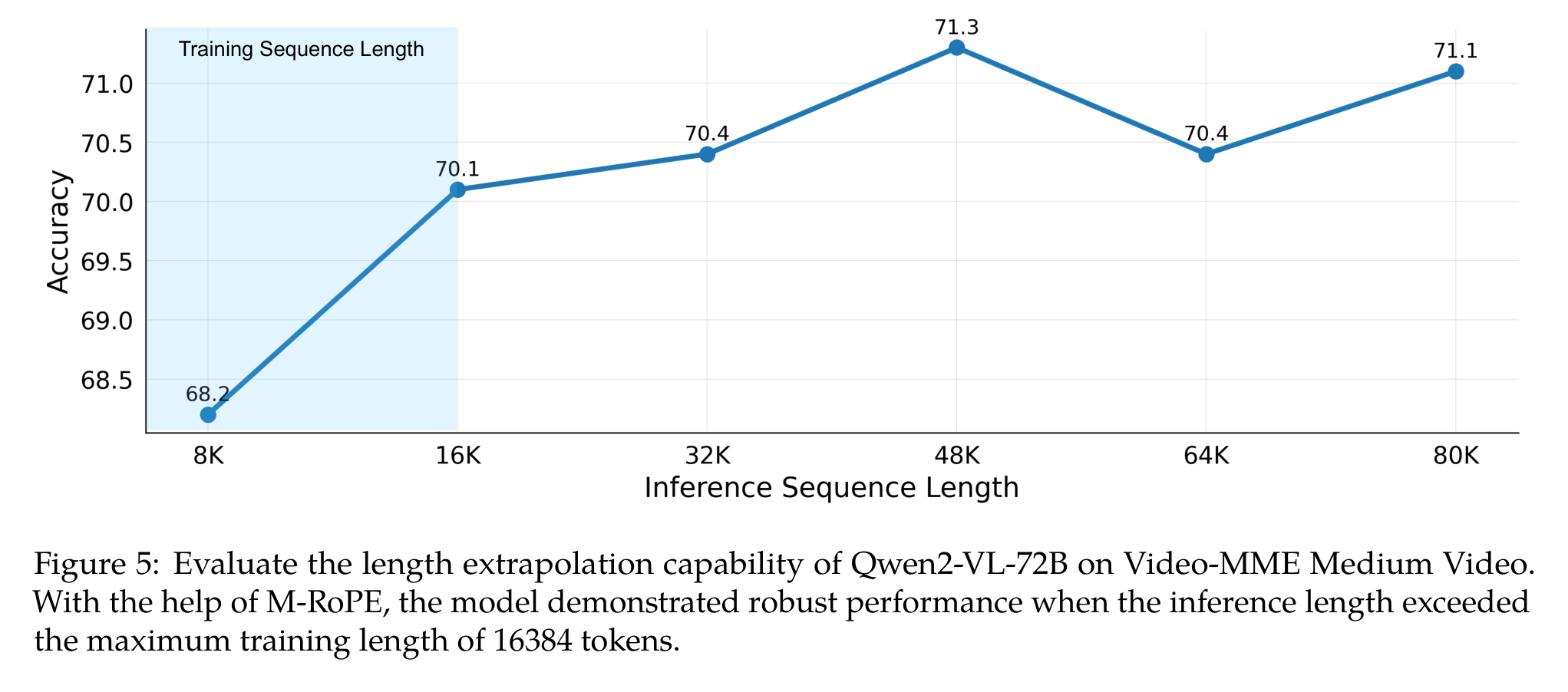
The evidence comes in two parts. In a controlled pre-training ablation (Qwen2-1.5B + ViT-L, Table 8), M-RoPE beats 1D-RoPE on most benchmarks, with the largest gains on video: NextQA 43.9 → 46.0, STAR 55.5 → 57.9, PerceptionTest 46.6 → 47.4, and MathVista 39.2 → 43.4. It is not uniform; RealWorldQA (54.5 → 53.7) and InfoVQA (50.8 → 50.3) dip slightly. On length extrapolation (Figure 5), Qwen2-VL-72B was trained with at most 16,384 tokens per video, yet holds its Video-MME accuracy at inference lengths up to 80K tokens.
Key Points
- 1
Rotary embedding is split into temporal, height and width components; every token carries a triple (t,h,w)
- 2
Text: t=h=w, so M-RoPE is equivalent to 1D-RoPE for pure language
- 3
Images: constant temporal ID; height and width IDs follow the token position in the 2D grid
- 4
Video: temporal ID increments per frame; height and width follow the image pattern
- 5
Modalities are concatenated by starting each one at previous max ID + 1
- 6
Position IDs for visual content grow with the grid side, not the token count, which helps length extrapolation
- 7
Table 8 (Qwen2-1.5B + ViT-L): M-RoPE vs 1D-RoPE: MathVista 43.4 vs 39.2, NextQA 46.0 vs 43.9, STAR 57.9 vs 55.5; small dips on RWQ and InfoVQA
- 8
Figure 5: trained at a 16,384-token video cap, Qwen2-VL-72B stays robust on Video-MME medium videos up to an 80K-token inference length
Mathematical Formulation
Position triples by modality
(t,h,w)=⎩⎨⎧(n,n,n)(s,s+r,s+c)(s+f,s+r,s+c)textimagevideo
A text token at sequence index n uses n for all three components. A visual token at row r, column c (and frame f for video) is offset by the modality start s. In Figure 3 the video starts at s=0, so its tokens read directly as (f,r,c). The rotary dimensions are partitioned among the three components, and each partition is rotated by its own ID.
Chaining modalities
sk+1=1+maxi∈kmax(ti,hi,wi)
Each new segment k+1 starts one past the largest ID used by any token i in the previous segment k. In Figure 3 the largest video ID is the width index 3, so the following text starts at (4,4,4).
Qwen2-VL trains on a mix of image and video data and runs both through one pipeline, instead of keeping a separate video branch. Three decisions make that work.
Sample densely. Each video is sampled at two frames per second, to keep as much temporal information as possible. Encode tubes, not patches. The ViT front-end uses 3D convolutions with a depth of two, following ViViT-style tubelet embedding. Each token covers two consecutive frames, which handles more frames without increasing sequence length. Make images a degenerate video. For consistency, every image is treated as two identical frames, so the same 3D convolution serves both modalities and there is no image-only path.
Long videos then run into the token budget. Rather than dropping frames, Qwen2-VL dynamically lowers the resolution of each frame so that the total tokens per video stay at or below 16,384. This is dynamic resolution in the temporal direction: a short clip gets sharp frames, a long one gets more but coarser frames. Combined with M-RoPE's per-frame temporal IDs, this is what allows the paper's claim of understanding videos over 20 minutes long.
There is a cost the paper acknowledges. At evaluation, frames per video were capped at 768, which the authors say may have hurt Video-MME on hour-long videos.
Key Points
- 1
Mixed image + video training in a single pipeline, without a separate video encoder
- 2
Videos are sampled at 2 frames per second
- 3
3D convolution with temporal depth 2: tokens are 3D tubes (2 frames × patch) instead of 2D patches, which halves sequence length per frame
- 4
Each image is treated as two identical frames, so images and video share the same encoder path
- 5
Frame resolution is adjusted dynamically so a video never exceeds 16,384 tokens
- 6
Enables 20-minute-plus video understanding; at evaluation, frames were capped at 768 per video
Mathematical Formulation
Video token budget
Nvideo≈2T⋅28H⋅28W≤16384
T sampled frames (2 per second) are grouped in pairs by the depth-2 3D convolution, and each pair is tokenised like an image. For a fixed budget, longer videos (larger T) force smaller H×W per frame.
Training follows the Qwen-VL template in three stages, and the order of what gets unfrozen matters.
Stage 1 trains only the ViT, on a large corpus of image-text pairs, plus OCR and image classification data, for about 600B tokens. The LLM starts from Qwen2 and the ViT from DFN (with RoPE-2D replacing its fixed position embedding). The goal is to teach the new native-resolution encoder to produce features the LLM can use, without disturbing the LLM.
Stage 2 unfreezes everything and trains on 800B more tokens of image-related data. This includes more interleaved image-text content, VQA, multitask data, and continued pure-text data to keep the language ability intact. Across both stages the model sees 1.4T tokens, and image tokens are input only: supervision is applied to text tokens alone. The data mixes cleaned web pages, open-source datasets and synthetic data, with a knowledge cutoff of June 2023.
Stage 3 locks the ViT and instruction-tunes the LLM on ChatML-formatted data. This covers pure-text dialogue plus image QA, document parsing, multi-image comparison, video comprehension, video-stream dialogue and agent interactions.
The data format uses special tokens. <|vision_start|>/<|vision_end|> wrap visual content. For grounding, boxes are written as text coordinates normalised to [0, 1000) between <|box_start|> and <|box_end|>, and the referred phrase sits between <|object_ref_start|> and <|object_ref_end|>. Agent tasks are posed as multi-step decision problems: the system prompt lists permissible actions, and the model emits *FUNCTION*/*ARGS* calls with screenshots returned as *RESULT*.
Infrastructure is described too. Training ran on Alibaba Cloud PAI-Lingjun with 3D parallelism (DP + TP + PP), ZeRO-1, sequence parallelism with selective activation checkpointing, 1F1B pipeline parallelism for the 72B model, PyTorch 2.1.2 / CUDA 11.8, and flash-attention in both the ViT and the LLM.
Key Points
- 1
Stage 1 — ViT only: image-text pairs, OCR and image classification, about 600B tokens
- 2
Stage 2 — all parameters: 800B additional tokens of mixed image-text, VQA, multitask, video and pure text data
- 3
1.4T pre-training tokens in total; loss only on text tokens, never on image tokens
- 4
Stage 3 — ViT frozen: LLM instruction tuning on ChatML data (image QA, documents, multi-image, video, video-stream dialogue, agents)
- 5
Initialisation: LLM from Qwen2, ViT from DFN with RoPE-2D; data knowledge cutoff June 2023
- 6
Grounding: boxes as text normalised to [0, 1000) with <|box_start|>/<|box_end|> and <|object_ref_start|>/<|object_ref_end|>
- 7
Infra: 3D parallelism (DP/TP/PP), ZeRO-1, sequence parallelism, 1F1B PP for 72B, flash-attention throughout
Mathematical Formulation
Pre-training token budget
stage 1: ViT600B+stage 2: all800B=1.4T
Image tokens appear in the input at both stages, but only text tokens contribute to the next-token loss. Stage 3 is instruction tuning and is not counted in this total.
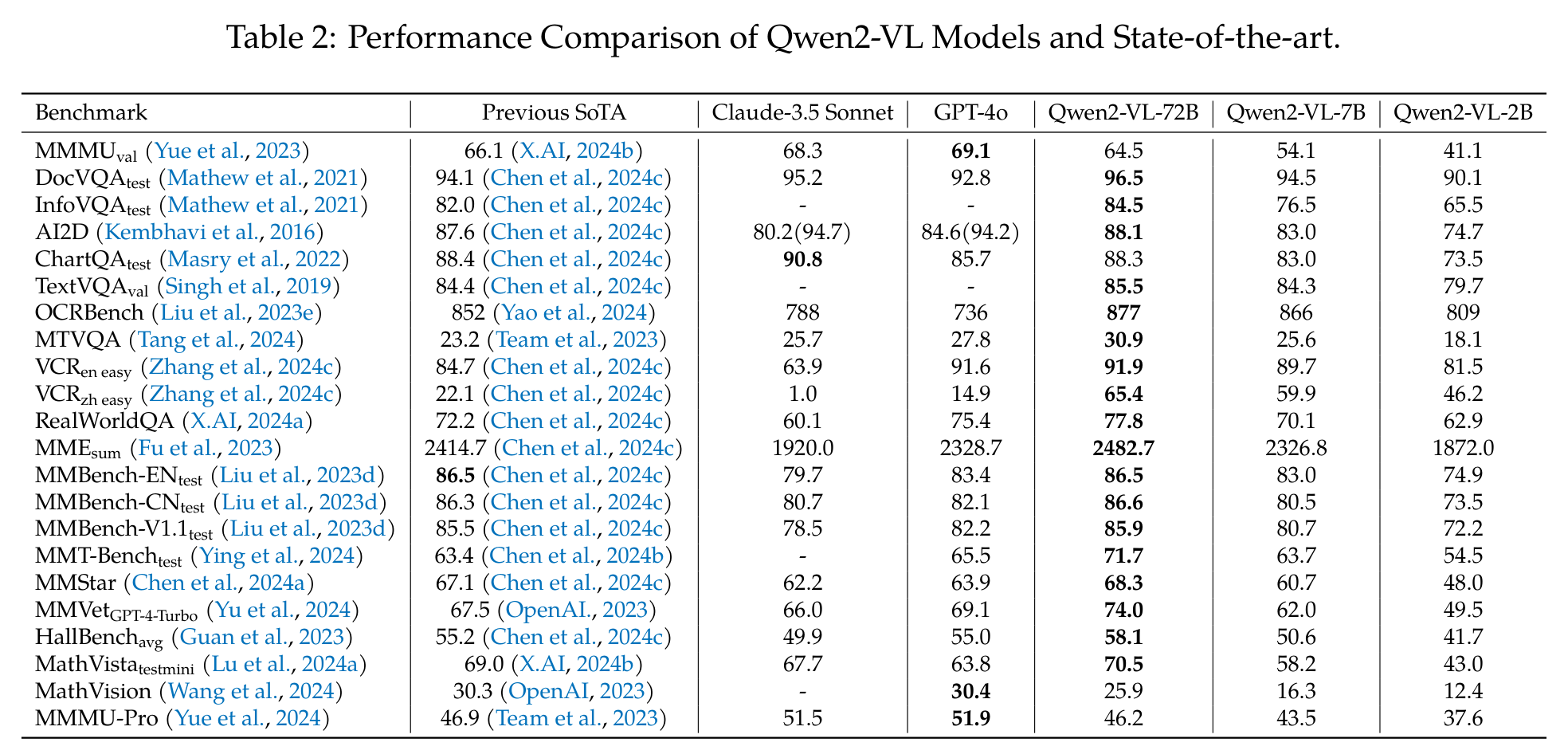
The headline comparison (Table 2) puts Qwen2-VL-72B against the previous state of the art, Claude 3.5 Sonnet and GPT-4o. The pattern matches the paper's thesis: native resolution helps most where detail matters.
On documents and OCR it leads. It scores 96.5 on DocVQA (GPT-4o 92.8, Claude 3.5 Sonnet 95.2), 84.5 on InfoVQA (previous best 82.0), and 877 on OCRBench (previous best 852, GPT-4o 736). On general VQA it reaches 77.8 on RealWorldQA vs GPT-4o's 75.4, 74.0 on MMVet, 71.7 on MMT-Bench vs a previous best of 63.4, and 2482.7 on MME. On multilingual OCR, it scores 30.9 on MTVQA, and on the internal benchmark (Table 3) it beats GPT-4o in every language except Arabic (70.7 vs 75.9). MathVista reaches 70.5. The smaller models hold up: the 7B scores 94.5 on DocVQA and 866 on OCRBench, and the 2B scores 90.1 on DocVQA.
Video (Table 4) is strong at 72B: 73.6 MVBench, 68.0 PerceptionTest and 77.9 EgoSchema, ahead of GPT-4o's 72.2. On Video-MME it scores 71.2 / 77.8 (without / with subtitles), roughly level with GPT-4o and below Gemini 1.5-Pro's 75.0 / 81.3. The authors attribute part of this to the 768-frame evaluation cap.
The paper is explicit about the gaps. On MMMU (64.5 vs GPT-4o's 69.1), MMMU-Pro (46.2 vs 51.9) and MathVision (25.9 vs 30.4), Qwen2-VL-72B trails. These are the college-level, reasoning-heavy benchmarks, and the authors read them as the model's room to improve on complex problems. Grounding (Table 6) is strong for a generalist: 93.2 on RefCOCO val, up from Qwen-VL's 89.4.


Key Points
- 1
DocVQA 96.5 (72B), ahead of Claude 3.5 Sonnet (95.2), GPT-4o (92.8) and the previous best (94.1)
- 2
OCRBench 877 (72B) vs a previous best of 852 and GPT-4o at 736; the 7B already scores 866
- 3
RealWorldQA 77.8, MMStar 68.3, MMVet 74.0, MMT-Bench 71.7, MME 2482.7, all at or above the previous state of the art
- 4
MathVista 70.5 (previous best 69.0); MathVision 25.9, below GPT-4o (30.4)
- 5
MMMU 64.5 vs GPT-4o 69.1 and MMMU-Pro 46.2 vs 51.9: the paper names complex college-level problems as the main gap
- 6
Multilingual OCR (Table 3): beats GPT-4o in Korean (94.5 vs 87.8), Japanese, French, German, Italian, Russian and Vietnamese; trails in Arabic (70.7 vs 75.9)
- 7
Video (Table 4): MVBench 73.6, PerceptionTest 68.0, EgoSchema 77.9; Video-MME 71.2/77.8 vs Gemini 1.5-Pro 75.0/81.3
- 8
Referring expressions (Table 6): 93.2 RefCOCO val for 72B, ahead of Qwen-VL (89.4) and the other generalists listed
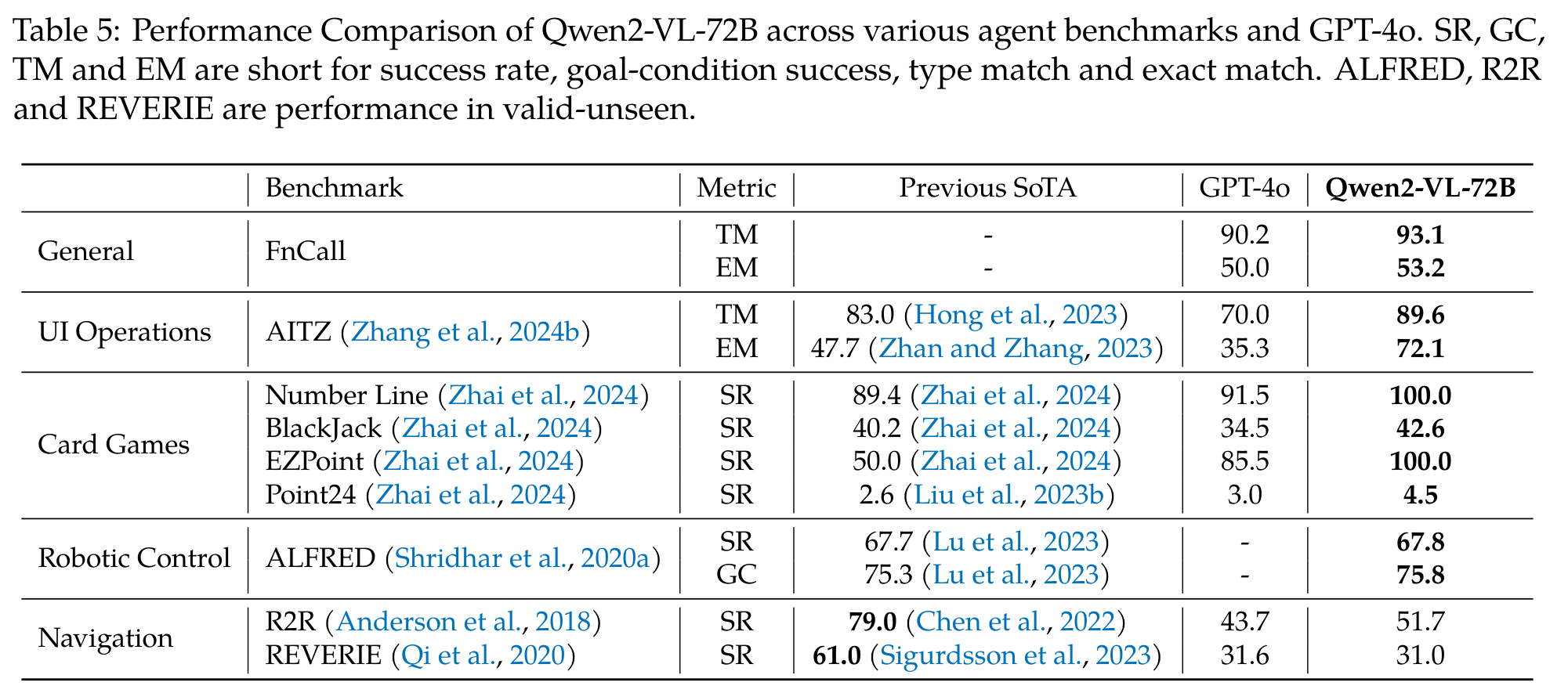
The paper positions Qwen2-VL as a general vision-language agent. Every task, whether phone UI, robotics, card games or navigation, is framed as sequential decision-making. The model observes a screenshot, reasons, picks an action from a defined set, receives the next observation, and repeats. The (observation, action) history stays in a 32K context, with a new image appended after every action.
Function calling comes first, on an internal benchmark built because no public LVLM function-calling benchmark existed. Qwen2-VL-72B beats GPT-4o on both picking the right function (Type Match 93.1 vs 90.2) and passing exactly the right arguments read from the image (Exact Match 53.2 vs 50.0). The authors attribute GPT-4o's deficit to conservative tool avoidance and weaker OCR, especially on Chinese text.
UI operation shows the largest margin. On AITZ, Qwen2-VL reaches 89.6 TM / 72.1 EM against a previous best of 83.0 / 47.7 and GPT-4o's 70.0 / 35.3. This is where native-resolution grounding pays off: exact match requires tapping the right coordinates. Card games from RL4VLM need OCR as well as planning; Number Line and EZPoint reach 100.0 success. ALFRED robotic control (with SAM for object localisation) edges past the specialist ThinkBot, at 67.8 SR / 75.8 GC.
Navigation is the clear failure. On R2R, Qwen2-VL scores 51.7 against a specialist's 79.0, and on REVERIE 31.0 against 61.0. It is roughly level with GPT-4o, and both are far behind specialist models. The authors blame incomplete, unstructured map information assembled from multiple images, and call 3D map and location modelling a major open challenge for multimodal models.
Key Points
- 1
Agent tasks framed as multi-step decision-making: observe → reason → act → new observation, with history kept in a 32K context
- 2
Function calling (internal benchmark): TM 93.1 / EM 53.2 vs GPT-4o 90.2 / 50.0
- 3
AITZ phone UI: TM 89.6 / EM 72.1 vs previous SoTA 83.0 / 47.7 and GPT-4o 70.0 / 35.3
- 4
Card games (RL4VLM): Number Line 100.0, EZPoint 100.0, BlackJack 42.6, Point24 4.5 success rate
- 5
ALFRED (valid-unseen, with SAM): 67.8 SR / 75.8 GC, slightly above the specialist ThinkBot (67.7 / 75.3)
- 6
Navigation is the weak spot: R2R 51.7 vs specialist 79.0; REVERIE 31.0 vs 61.0, roughly level with GPT-4o
- 7
Diagnosis: incomplete, unstructured map information from multiple images; 3D spatial modelling remains open
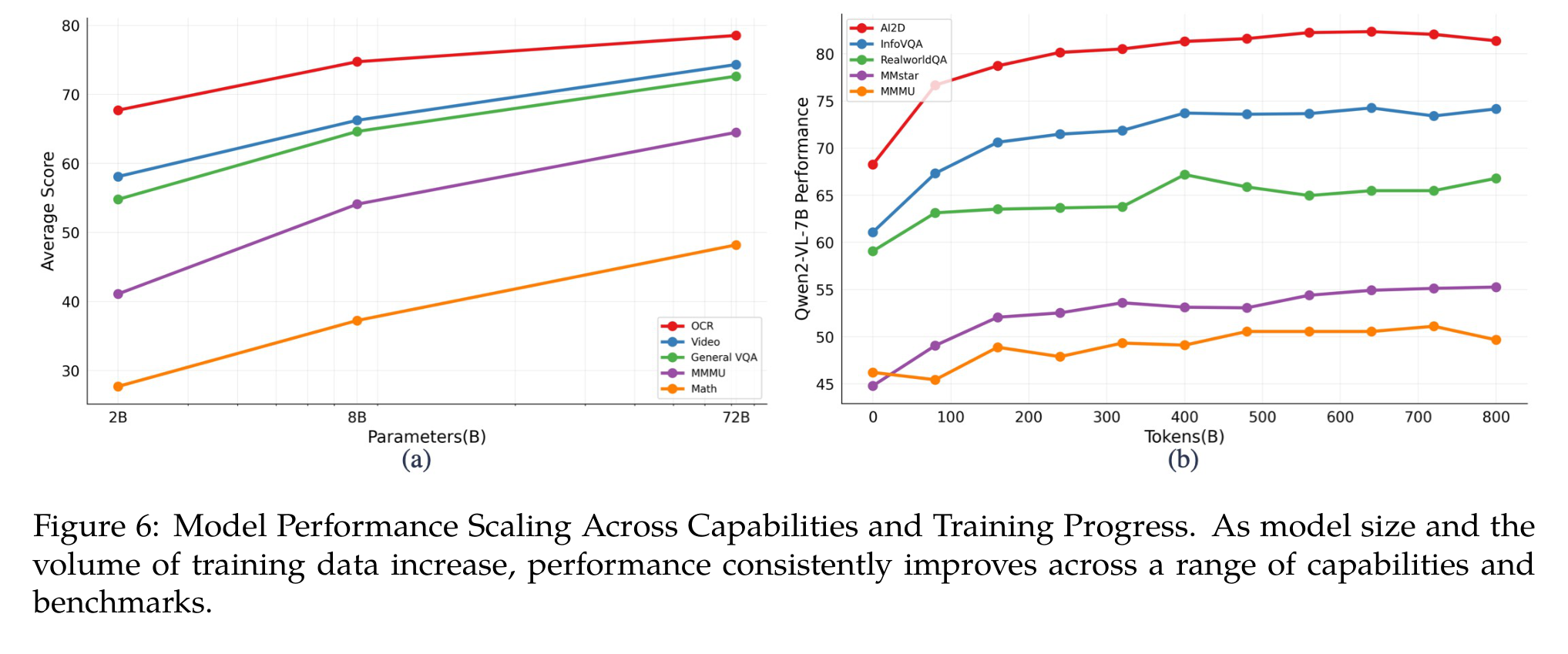
The paper also makes a first pass at scaling behaviour for LVLMs, along two axes (Figure 6).
Model size (Figure 6a): capabilities are grouped into college-level problem solving (MMMU), math (MathVista + MathVision), document and table understanding, general VQA, and video. Performance rises consistently from 2B to 7B to 72B. Mathematical ability correlates most clearly with parameter count, while OCR-heavy tasks are already strong at small scale. This fits the architecture: perception lives largely in the shared 675M ViT, while multi-step reasoning lives in the LLM.
Training data (Figure 6b): during stage-2 pre-training of Qwen2-VL-7B, performance generally improves with more tokens. General VQA fluctuates, while text-and-graphics tasks such as AI2D and InfoVQA improve steadily.
The limits are stated plainly across the paper. Qwen2-VL-72B still lags GPT-4o on MMMU, the hardest reasoning benchmark. Bigger is not always better for inputs: upscaling small images past a point pushes them out of distribution and hurts OCRBench. Long video is bounded by the 768-frame evaluation cap, and the authors list longer sequences as future work. Embodied navigation remains far behind specialist models. Qwen2.5-VL, the successor, addresses several of these directly, with absolute-time MRoPE, window attention in the ViT and stronger agent grounding.
Key Points
- 1
Figure 6(a): performance improves consistently with model size across all five capability groups
- 2
Math scales most clearly with parameters; OCR is already strong in smaller models
- 3
Figure 6(b): more stage-2 tokens help overall; VQA fluctuates, while AI2D and InfoVQA rise steadily
- 4
Remaining gaps: MMMU (64.5 vs GPT-4o 69.1), MathVision, Arabic OCR, and vision-language navigation
- 5
Too-aggressive upscaling (min_pixels) hurts OCRBench: choosing an appropriate resolution matters more than maximising it
- 6
Video evaluation was capped at 768 frames; extending to longer sequences is named as future work
Keep reading
Related Papers
Go deeper